Ch. 12 - Regulation of Gene Expression in Bacteria and Bacteriophage
Sanders - Genetic Analysis: An Integrated Approach 3rd Edition
Sanders3rd EditionGenetic Analysis: An Integrated ApproachISBN: 9780135564172당신이 사용하는 게 아니라요?교과서 변경
12장, 문제 18

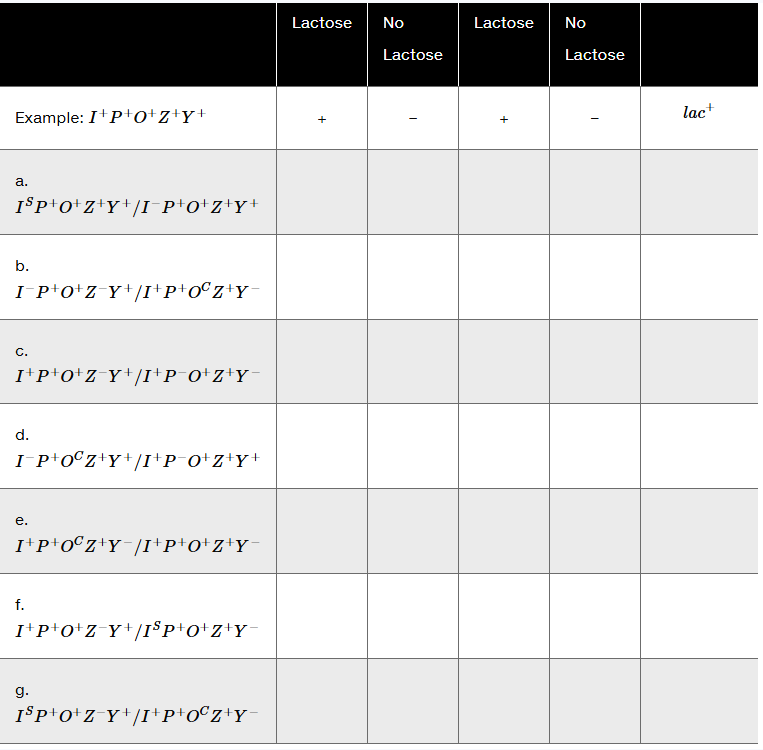
Complete the accompanying table, indicating whether functionally active -galactosidase and permease are produced in the presence and absence of lactose. Use '+' to indicate the presence of a functional enzyme and '−' to indicate its absence. Indicate whether the partial diploid strain is lac⁺ (able to grow on lactose-only medium) or lac⁻ (cannot grow on lactose medium).
Table for recording presence (+) or absence (−) of active β-galactosidase and permease enzymes with lactose conditions and lac⁺/lac⁻ strain status.

검증된 단계별 안내
1
Step 1: Understand the lac operon system, which controls the production of β-galactosidase and permease enzymes. These enzymes are involved in lactose metabolism, where β-galactosidase breaks down lactose and permease facilitates lactose entry into the cell.
Step 2: Identify the genetic components involved in the partial diploid strain, including the lacZ gene (encoding β-galactosidase), lacY gene (encoding permease), and the regulatory elements such as the lacI repressor and the operator site. Determine which alleles are present on each chromosome in the diploid.
Step 3: Analyze the presence or absence of lactose. In the absence of lactose, the lacI repressor binds to the operator, preventing transcription of lacZ and lacY, so both enzymes are typically not produced (indicated by '−'). In the presence of lactose, the repressor is inactivated, allowing transcription and production of both enzymes (indicated by '+').
Step 4: For each genotype in the partial diploid, determine whether functional β-galactosidase and permease are produced in the presence and absence of lactose by considering the effects of mutations or regulatory changes on gene expression.
Step 5: Based on the enzyme production patterns, decide if the partial diploid strain is lac⁺ (if it produces functional enzymes and can grow on lactose-only medium) or lac⁻ (if it cannot produce functional enzymes and cannot grow on lactose).

비슷한 문제에 대한 검증된 영상 답변:

이 영상 해법은 위 문제에 도움이 된다고 튜터들이 추천한 것입니다.
영상 길이:
3m
도움이 되었나요?

주요 개념

질문에 올바르게 답하기 위해 반드시 이해해야 하는 핵심 개념들은 다음과 같습니다.

Lac Operon Structure and Function

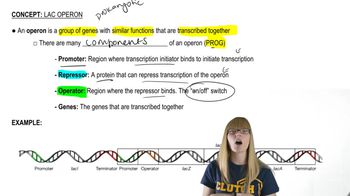
The lac operon is a set of genes in E. coli responsible for lactose metabolism, including genes for β-galactosidase and permease. It is regulated by the presence or absence of lactose, which acts as an inducer to enable transcription of these genes. Understanding this operon is essential to predict enzyme production under different conditions.
추천 영상:
가이드 코스
04:27
Lac Operon Overview

Role of β-Galactosidase and Permease

β-galactosidase breaks down lactose into glucose and galactose, while permease facilitates lactose entry into the cell. The presence or absence of these functional enzymes determines whether the bacteria can metabolize lactose and grow on lactose-only medium, making their activity critical for lac⁺ or lac⁻ classification.
추천 영상:
가이드 코스
04:27
Lac Operon Overview

Partial Diploid Strains and Gene Regulation

Partial diploids carry two copies of the lac operon, allowing analysis of dominant and recessive mutations in regulatory and structural genes. This helps determine how mutations affect enzyme production and lactose metabolism, which is key to interpreting the phenotype (lac⁺ or lac⁻) in the presence or absence of lactose.
추천 영상:
가이드 코스
27:36
Diploid Genetics
관련 실천
교과서 질문

Identify which of the following lac operon haploid genotypes transcribe operon genes inducibly and which transcribe genes constitutively. Indicate whether the strain is lac⁺ (able to grow on lactose-only medium) or lac⁻ (cannot grow on lactose medium).

I⁺ P⁺ Oᶜ Z⁺ Y⁺

530
views
교과서 질문

List possible genotypes for lac operon haploids that have the following phenotypic characteristics:

The operon genes are never transcribed above a basal level, and the strain is unable to grow on a lactose medium. List two possible genotypes for this phenotype.

575
views
교과서 질문

List possible genotypes for lac operon haploids that have the following phenotypic characteristics:

The operon genes are inducibly transcribed, but the strain is unable to grow on a lactose medium. List one possible genotype for this phenotype.

559
views
교과서 질문

List possible genotypes for lac operon haploids that have the following phenotypic characteristics:

The operon genes are constitutively transcribed, but the strain is unable to grow on a lactose medium. List two possible genotypes for this phenotype.

582
views
교과서 질문

Identify which of the following lac operon haploid genotypes transcribe operon genes inducibly and which transcribe genes constitutively. Indicate whether the strain is lac⁺ (able to grow on lactose-only medium) or lac⁻ (cannot grow on lactose medium).

I⁺ P⁺ O⁺ Z⁻ Y⁺

575
views
교과서 질문

Identify which of the following lac operon haploid genotypes transcribe operon genes inducibly and which transcribe genes constitutively. Indicate whether the strain is lac⁺ (able to grow on lactose-only medium) or lac⁻ (cannot grow on lactose medium).

I⁺ P⁺ Oᶜ Z⁺ Y⁻

549
views