Ch. 12 - Regulation of Gene Expression in Bacteria and Bacteriophage
Sanders - Genetic Analysis: An Integrated Approach 3rd Edition
Sanders3rd EditionGenetic Analysis: An Integrated ApproachISBN: 9780135564172당신이 사용하는 게 아니라요?교과서 변경
12장, 문제 21

Four independent lac⁻ mutants (mutants A to D) are isolated in haploid strains of E. coli. The strains have the following phenotypic characteristics:
Mutant A is lac⁻, but transcription1 of operon genes is induced by lactose.
Mutant B is lac⁻ and has uninducible2 transcription of operon genes.
Mutant C is lac⁺ and has constitutive3 transcription of operon genes.
Mutant D is lac⁺ and has constitutive3 transcription of operon genes.
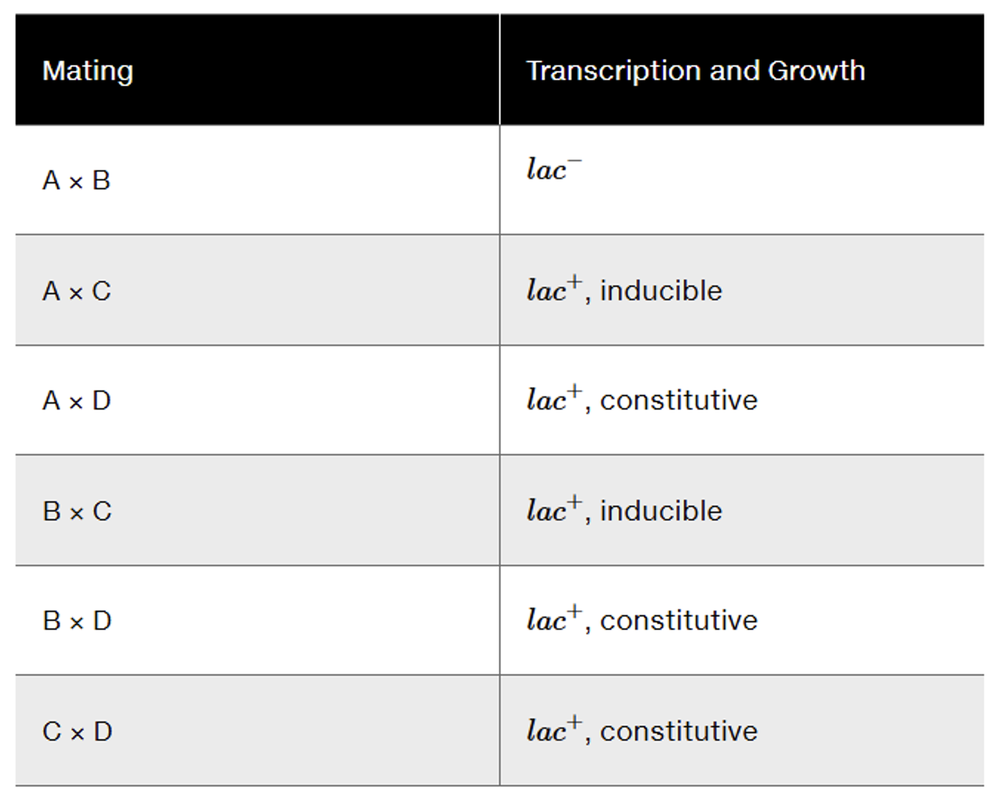
A microbiologist develops donor and recipient varieties of each mutant strain and crosses them with the results shown below. The table indicates whether inducible, constitutive, or noninducible transcription occurs, along with lac+ and lac⁻ growth habit for each partial diploid. Assume each strain has a single mutation.
Table showing mating results and transcription characteristics of four lac mutants in E. coli.
Use this information to identify which lac operon gene is mutated in each strain.

검증된 단계별 안내
1
Step 1: Understand the lac operon system. The lac operon in E. coli is a set of genes involved in lactose metabolism. It includes structural genes (lacZ, lacY, lacA) and regulatory elements (promoter, operator, and the lacI gene encoding the repressor). Mutations in these components can affect transcription in different ways: inducible (normal regulation), constitutive (always on), or noninducible (always off).
Step 2: Analyze the phenotypes of the mutants. Mutant A is lac⁻ but inducible, suggesting a mutation in a structural gene (e.g., lacZ or lacY) that does not affect regulation. Mutant B is lac⁻ and uninducible, indicating a mutation in a regulatory element that prevents transcription entirely (e.g., lacP or lacO). Mutants C and D are lac⁺ and constitutive, suggesting mutations that disrupt repression (e.g., lacI or lacO).
Step 3: Examine the results of the partial diploid matings. For example, in the A × C cross, the phenotype is lac⁺ and inducible. This suggests that the mutation in A is complemented by the wild-type allele in C, and the mutation in C does not affect inducibility. This points to A having a structural gene mutation and C having a regulatory mutation (e.g., lacI or lacO).
Step 4: Use the complementation test results to assign mutations. For instance, in the B × C cross, the phenotype is lac⁺ and inducible. This indicates that the mutation in B is complemented by the wild-type allele in C, and the mutation in C does not prevent inducibility. This suggests B has a mutation in a regulatory element (e.g., lacP) and C has a mutation in lacI or lacO.
Step 5: Summarize the mutations. Based on the data, Mutant A likely has a structural gene mutation (e.g., lacZ or lacY), Mutant B has a mutation in the promoter (lacP), Mutant C has a mutation in the repressor (lacI), and Mutant D has a mutation in the operator (lacO). These assignments are consistent with the phenotypes and complementation test results.

비슷한 문제에 대한 검증된 영상 답변:

이 영상 해법은 위 문제에 도움이 된다고 튜터들이 추천한 것입니다.
영상 길이:
5m

주요 개념

질문에 올바르게 답하기 위해 반드시 이해해야 하는 핵심 개념들은 다음과 같습니다.

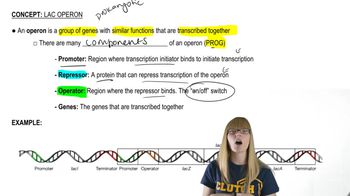
Lac Operon Structure and Function

The lac operon is a set of genes in E. coli that are involved in the metabolism of lactose. It consists of three structural genes (lacZ, lacY, and lacA) and regulatory elements that control their expression. The operon is typically off but can be induced by lactose, which binds to the repressor protein, allowing transcription of the genes necessary for lactose utilization.
추천 영상:
가이드 코스
04:27
Lac Operon Overview

Mutations and Their Effects

Mutations in the lac operon can lead to different phenotypes, such as lac⁻ (non-functional) or lac⁺ (functional). Specific mutations can affect the repressor's ability to bind to the operator or alter the promoter's activity, resulting in uninducible or constitutive expression of the operon. Understanding these mutations is crucial for determining the functional status of each mutant strain.
추천 영상:
가이드 코스
03:38
Maternal Effect

Partial Diploids and Complementation

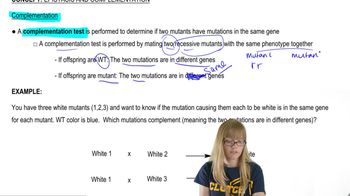
In genetic studies, partial diploids are created by introducing a second copy of a gene into a haploid organism, allowing researchers to study gene interactions. In the context of the lac operon, crossing different mutants can reveal whether a mutation is dominant or recessive, and whether the mutations can complement each other to restore function, which is essential for identifying the specific mutations in each strain.
추천 영상:
가이드 코스
05:05
Complementation
관련 실천