Ch. 13 - Regulation of Gene Expression in Eukaryotes
Sanders - Genetic Analysis: An Integrated Approach 3rd Edition
Sanders3rd EditionGenetic Analysis: An Integrated ApproachISBN: 9780135564172당신이 사용하는 게 아니라요?교과서 변경
13장, 문제 2b

Describe and give an example (real or hypothetical) of each of the following:
Insulator sequence action

검증된 단계별 안내
1
Understand the concept of an insulator sequence: An insulator sequence is a DNA element that acts as a boundary or barrier to prevent the interaction between enhancers and promoters of adjacent genes. It ensures that regulatory elements like enhancers only affect their target gene and not neighboring genes.
Explain the two main functions of insulator sequences: (1) Blocking enhancer-promoter interactions when placed between them, and (2) acting as a barrier to prevent the spread of heterochromatin into euchromatic regions, thereby maintaining gene expression patterns.
Provide a real-world example: The best-known example of an insulator sequence is the CTCF-binding site in vertebrates. CTCF is a protein that binds to these insulator sequences and mediates their function. For instance, in the beta-globin gene cluster, CTCF-binding insulators prevent enhancers from activating non-target genes.
Provide a hypothetical example: Imagine two genes, Gene A and Gene B, located next to each other. If Gene A has an enhancer that could potentially activate Gene B, an insulator sequence placed between the enhancer and Gene B would block this interaction, ensuring that the enhancer only activates Gene A.
Summarize the importance of insulator sequences: Insulator sequences are crucial for maintaining proper gene regulation and preventing inappropriate gene activation, which could lead to developmental issues or diseases such as cancer.

비슷한 문제에 대한 검증된 영상 답변:

이 영상 해법은 위 문제에 도움이 된다고 튜터들이 추천한 것입니다.
영상 길이:
3m

주요 개념

질문에 올바르게 답하기 위해 반드시 이해해야 하는 핵심 개념들은 다음과 같습니다.

Insulator Sequences

Insulator sequences are DNA elements that function to block the interaction between enhancers and promoters, thereby regulating gene expression. They act as boundary elements that prevent the spread of heterochromatin and maintain the integrity of gene regulatory domains. For example, the CTCF protein binds to insulator sequences, helping to organize the three-dimensional structure of the genome.
추천 영상:
가이드 코스
08:41
Sequencing Difficulties

Gene Regulation

Gene regulation refers to the mechanisms that control the expression of genes, determining when and how much of a gene product is made. This process is crucial for cellular differentiation and response to environmental signals. Insulators play a key role in gene regulation by ensuring that only the intended genes are activated in response to specific signals, preventing unintended gene activation.
추천 영상:
가이드 코스
09:22
Review of Regulation

Chromatin Structure

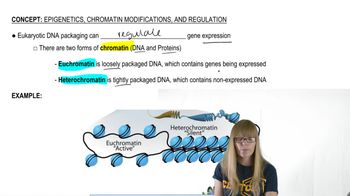
Chromatin structure refers to the organization of DNA and proteins in the nucleus, which influences gene accessibility and expression. Chromatin can exist in a more condensed form (heterochromatin) or a more relaxed form (euchromatin), affecting gene activity. Insulators help maintain this structure by preventing the inappropriate spread of heterochromatin, thus preserving the functional state of active genes.
추천 영상: