Ch. 4 - Gene Interaction
Sanders - Genetic Analysis: An Integrated Approach 3rd Edition
Sanders3rd EditionGenetic Analysis: An Integrated ApproachISBN: 9780135564172당신이 사용하는 게 아니라요?교과서 변경
4장, 문제 15a

A plant line with reduced fertility comes to the attention of a plant breeder who observes that seed pods often contain a mixture of viable seeds that can be planted to produce new plants and withered seeds that cannot be sprouted. The breeder examines numerous seed pods in the reduced fertility line and counts 622 viable seeds and 204 nonviable seeds.
What single-gene mechanism best explains the breeder's observation?

검증된 단계별 안내
1
The first step is to recognize that the problem involves a genetic mechanism that affects seed viability. The observation of both viable and nonviable seeds in the same seed pod suggests a genetic phenomenon related to segregation or lethality.
Next, consider the possibility of a single-gene mechanism. A likely explanation is that the reduced fertility is caused by a recessive lethal allele. This means that individuals homozygous for the lethal allele (genotype: aa) do not survive, while heterozygous (Aa) and homozygous dominant (AA) individuals are viable.
To test this hypothesis, calculate the expected genotypic ratios from a heterozygous cross (Aa × Aa). The Punnett square for this cross predicts the following genotypes: AA, Aa, Aa, and aa, with a ratio of 1:2:1.
Since the aa genotype is lethal, only the AA and Aa genotypes contribute to viable seeds. This results in a phenotypic ratio of 3 viable seeds (1 AA + 2 Aa) to 1 nonviable seed (aa).
Finally, compare the observed data (622 viable seeds and 204 nonviable seeds) to the expected 3:1 ratio. Use a chi-square test to determine if the observed data fits the expected ratio, which would confirm the hypothesis of a recessive lethal allele as the single-gene mechanism.

비슷한 문제에 대한 검증된 영상 답변:

이 영상 해법은 위 문제에 도움이 된다고 튜터들이 추천한 것입니다.
영상 길이:
2m

주요 개념

질문에 올바르게 답하기 위해 반드시 이해해야 하는 핵심 개념들은 다음과 같습니다.

Mendelian Inheritance

Mendelian inheritance refers to the principles of heredity established by Gregor Mendel, which describe how traits are passed from parents to offspring through discrete units called genes. In this context, the observation of viable and nonviable seeds suggests a single-gene trait, where one allele may be dominant and responsible for seed viability, while the other allele leads to nonviable seeds.
추천 영상:
가이드 코스
05:13
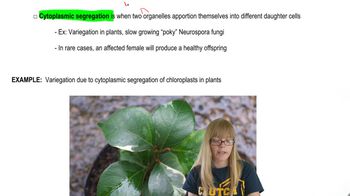
Organelle Inheritance

Genetic Ratio

The genetic ratio is a way to express the expected proportions of different genotypes or phenotypes resulting from a genetic cross. In this case, the ratio of viable to nonviable seeds (622:204) can be analyzed to determine if it aligns with a typical Mendelian ratio, such as 3:1, indicating a single-gene trait with one dominant and one recessive allele.
추천 영상:
가이드 코스
11:43
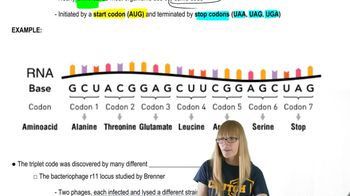
The Genetic Code

Allelic Interaction

Allelic interaction refers to how different alleles of a gene interact to influence a trait. In the scenario presented, the presence of both viable and nonviable seeds suggests that the gene in question may exhibit incomplete dominance or a simple dominant-recessive relationship, where the dominant allele produces viable seeds and the recessive allele results in nonviable seeds.
추천 영상:
가이드 코스
07:56
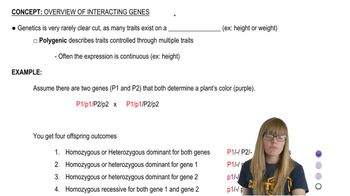
Interacting Genes Overview
관련 실천
교과서 질문

The coat color in mink is controlled by two codominant alleles at a single locus. Red coat color is produced by the genotype R₁R₁, silver coat by the genotype R₁R₂, and platinum color by R₂R₂. White spotting of the coat is a recessive trait found with the genotype ss. Solid coat color is found with the S– genotype.


What are the expected progeny phenotypes and proportions for the cross SsR₁R₂ x ssR₂R₂?

398
views
교과서 질문

Using the information provided in Problems 10 and 11, determine the genotype and phenotype of parents that produce the following progeny:

3/4 brown : 1/4 yellow

568
views
교과서 질문

Total cholesterol in blood is reported as the number of milligrams (mg) of cholesterol per 100 milliliters (mL) of blood. The normal range is 180–220 mg/100 mL. A gene mutation altering the function of cell-surface cholesterol receptors restricts the ability of cells to collect cholesterol from blood and draw it into cells. This defect results in elevated blood cholesterol levels. Individuals who are heterozygous for a mutant allele and a wild-type allele have levels of 300–600 mg/100 mL, and those who are homozygous for the mutation have levels of 800–1000 mg/100 mL. Identify the genetic term that best describes the inheritance of this form of elevated cholesterol level, and justify your choice.

703
views
교과서 질문

A plant line with reduced fertility comes to the attention of a plant breeder who observes that seed pods often contain a mixture of viable seeds that can be planted to produce new plants and withered seeds that cannot be sprouted. The breeder examines numerous seed pods in the reduced fertility line and counts 622 viable seeds and 204 nonviable seeds.

Propose an additional experiment to test the genetic mechanism you propose. If your hypothesis is correct, what experimental outcome do you predict?

478
views
교과서 질문

Flower color in snapdragons results from the amount of the pigment anthocyanin in the petals. Red flowers are produced by plants that have full anthocyanin production, and ivory-colored flowers are produced by plants that lack the ability to produce anthocyanin. The allele An1 has full activity in anthocyanin production, and the allele An2 is a null allele. Dr. Ara B. Dopsis, a famous genetic researcher, crosses pure-breeding red snapdragons to pure-breeding ivory snapdragons and produces F₁ progeny plants that have pink flowers. He proposes that this outcome is the result of incomplete dominance, and he crosses the F₁ to test his hypothesis. What phenotypes does Dr. Dopsis predict will be found in the F₂, and in what proportions?

452
views
교과서 질문

In cattle, an autosomal mutation called Dexter produces calves with short stature and short limbs. Embryos that are homozygous for the Dexter mutation have severely stunted development and either spontaneously abort or are stillborn. What progeny phenotypes do you expect from the cross of two Dexter cows? What are the expected proportions of the expected phenotypes?

623
views