Ch. 6 - Genetic Analysis and Mapping in Bacteria and Bacteriophages
Sanders - Genetic Analysis: An Integrated Approach 3rd Edition
Sanders3rd EditionGenetic Analysis: An Integrated ApproachISBN: 9780135564172당신이 사용하는 게 아니라요?교과서 변경
6장, 문제 1a

For bacteria that are F⁺, Hfr, F', and F⁻ perform or answer the following.
Describe the state of the F factor.

검증된 단계별 안내
1
Understand the F factor: The F factor (fertility factor) is a plasmid that allows bacteria to transfer genetic material through conjugation. It plays a key role in bacterial reproduction and genetic exchange.
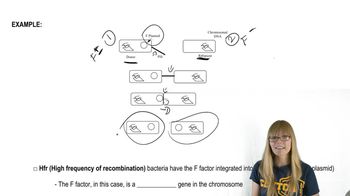
Describe the F⁺ state: In F⁺ bacteria, the F factor exists as an independent plasmid within the cytoplasm. These bacteria can initiate conjugation and transfer the F factor to F⁻ bacteria.
Describe the Hfr state: In Hfr (high frequency of recombination) bacteria, the F factor is integrated into the bacterial chromosome. During conjugation, these bacteria transfer chromosomal genes along with the F factor to recipient cells.
Describe the F' state: In F' bacteria, the F factor exists as a plasmid but carries additional chromosomal genes due to improper excision from the bacterial chromosome. These bacteria can transfer both the F factor and the extra chromosomal genes during conjugation.
Describe the F⁻ state: In F⁻ bacteria, the F factor is absent. These bacteria cannot initiate conjugation but can receive genetic material from F⁺, Hfr, or F' bacteria during conjugation.

비슷한 문제에 대한 검증된 영상 답변:

이 영상 해법은 위 문제에 도움이 된다고 튜터들이 추천한 것입니다.
영상 길이:
2m

주요 개념

질문에 올바르게 답하기 위해 반드시 이해해야 하는 핵심 개념들은 다음과 같습니다.

F Factor

The F factor, or fertility factor, is a plasmid in bacteria that contains genes necessary for the formation of sex pili and the process of conjugation. It can exist as a free plasmid (F⁺), integrated into the bacterial chromosome (Hfr), or as a modified plasmid that carries additional genes (F'). The presence and state of the F factor determine the bacterial cell's ability to transfer genetic material to another cell.
추천 영상:
가이드 코스
08:52
F Factor and Hfr

Conjugation

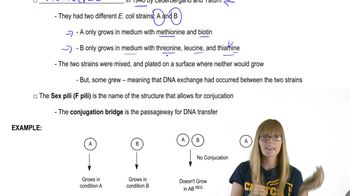
Conjugation is a form of horizontal gene transfer in bacteria where genetic material is transferred from one bacterium to another through direct contact. This process typically involves the formation of a pilus by the donor cell, allowing the transfer of the F factor or chromosomal DNA. Understanding conjugation is essential for grasping how genetic diversity is generated in bacterial populations.
추천 영상:
가이드 코스
04:06
Conjugation Overview

Hfr Strains

Hfr (high frequency of recombination) strains are bacteria in which the F factor is integrated into the chromosomal DNA. This integration allows for the transfer of chromosomal genes during conjugation, leading to genetic recombination. Hfr strains are important for studying gene mapping and understanding the mechanisms of genetic exchange in bacteria.
추천 영상:
가이드 코스
08:52
F Factor and Hfr