Ch. 9 - The Molecular Biology of Translation
Sanders - Genetic Analysis: An Integrated Approach 3rd Edition
Sanders3rd EditionGenetic Analysis: An Integrated ApproachISBN: 9780135564172당신이 사용하는 게 아니라요?교과서 변경
9장, 문제 5b

A portion of a DNA template strand has the base sequence
5′-...ACGCGATGCGTGATGTATAGAGCT...-3′
Assume the mRNA is written in the correct reading frame. Determine the amino acid sequence encoded by this fragment. Identify the N- and C-terminal directions of the polypeptide.

검증된 단계별 안내
1
Step 1: Identify the complementary mRNA sequence by transcribing the DNA template strand. Remember that RNA uses uracil (U) instead of thymine (T). The DNA template strand is read in the 3′ to 5′ direction, so the mRNA will be synthesized in the 5′ to 3′ direction. For example, A pairs with U, C pairs with G, G pairs with C, and T pairs with A.
Step 2: Divide the mRNA sequence into codons (groups of three nucleotides). Each codon corresponds to a specific amino acid or a stop signal during translation.
Step 3: Use the genetic code table to translate each codon into its corresponding amino acid. For example, AUG codes for methionine (start codon), and UAA, UAG, or UGA are stop codons.
Step 4: Determine the directionality of the polypeptide chain. Translation begins at the N-terminal (amino group) and proceeds toward the C-terminal (carboxyl group). The first amino acid corresponds to the start codon, and the sequence ends at the stop codon.
Step 5: Write out the amino acid sequence in order, starting from the N-terminal and ending at the C-terminal. Ensure that you include the start codon and stop translation at the stop codon.

비슷한 문제에 대한 검증된 영상 답변:

이 영상 해법은 위 문제에 도움이 된다고 튜터들이 추천한 것입니다.
영상 길이:
2m

주요 개념

질문에 올바르게 답하기 위해 반드시 이해해야 하는 핵심 개념들은 다음과 같습니다.

Transcription

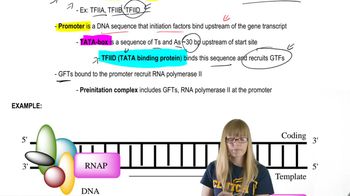
Transcription is the process by which the genetic information in DNA is copied into messenger RNA (mRNA). During this process, RNA polymerase binds to the DNA template strand and synthesizes a complementary RNA strand, replacing thymine (T) with uracil (U). Understanding transcription is essential for determining how the DNA sequence translates into an mRNA sequence, which is the first step in protein synthesis.
추천 영상:
가이드 코스
09:16
Eukaryotic Transcription

Translation

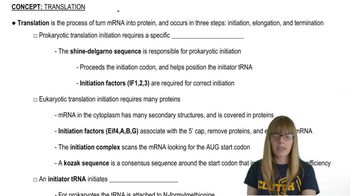
Translation is the process by which the mRNA sequence is decoded to synthesize a polypeptide chain, which will fold into a functional protein. This occurs in the ribosome, where transfer RNA (tRNA) molecules bring specific amino acids to the growing polypeptide chain based on the codon sequence of the mRNA. Recognizing how codons correspond to amino acids is crucial for determining the final amino acid sequence from the mRNA.
추천 영상:
가이드 코스
07:58
Translation initiation

Amino Acid Structure and Polypeptide Directionality

Amino acids are the building blocks of proteins, each consisting of a central carbon atom, an amino group, a carboxyl group, and a variable R group that determines the specific properties of the amino acid. In a polypeptide chain, the N-terminus refers to the end with a free amino group, while the C-terminus has a free carboxyl group. Understanding this directionality is important for correctly identifying the ends of the synthesized polypeptide and its functional implications.
추천 영상:
가이드 코스
03:49
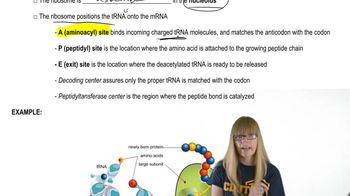
Ribosome Structure