Skip to main content
GOB Chemistry
나의 코스
배우기
시험 준비
AI 튜터
학습 가이드
교과서적 해결책
플래시카드
탐험해 보세요
앱을 사용해 보세요
나의 코스
배우기
시험 준비
AI 튜터
학습 가이드
교과서적 해결책
플래시카드
탐험해 보세요
앱을 사용해 보세요
뒤로
Alcohol Reactions: Dehydration Reactions quiz
카드를 뒤집기 위해 탭할 수 있습니다.
What is the main reagent used in the dehydration of alcohols to form alkenes?
카드를 뒤집기 위해 탭할 수 있습니다.
👆
What is the main reagent used in the dehydration of alcohols to form alkenes?
Sulfuric acid (H2SO4) is the main reagent used in the dehydration of alcohols to form alkenes.
진행 상황 추적
컨트롤 버튼이 '내비게이션' 모드로 변경되었습니다.
1/15
관련 플래시카드
관련 실천
추천 영상
Alcohol Reactions: Dehydration Reactions definitions
Alcohol Reactions: Dehydration Reactions
13 용어
Alcohol Reactions: Dehydration Reactions
14. Compounds with Oxygen or Sulfur
6 문제점
주제
Jules
Intro to Redox Reactions
14. Compounds with Oxygen or Sulfur
3 문제점
주제
Ernest
14. Compounds with Oxygen or Sulfur
7 주제
15 문제점
장
Jules
VideoThumbView.guidedCourse
1:30
Alcohol Reactions: Dehydration Reactions Concept 1
1568
views
6
rank
VideoThumbView.guidedCourse
1:24
Zaitsev’s Rule Concept 2
1641
views
5
rank
VideoThumbView.guidedCourse
1:13
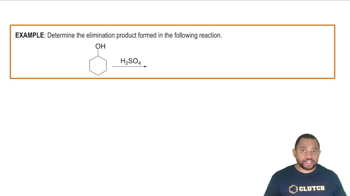
Alcohol Reactions Dehydration Reactions Example 1
1529
views
10
rank
이 집합의 용어 (15)
하이드의 정의
What is the main reagent used in the dehydration of alcohols to form alkenes?
Sulfuric acid (H2SO4) is the main reagent used in the dehydration of alcohols to form alkenes.
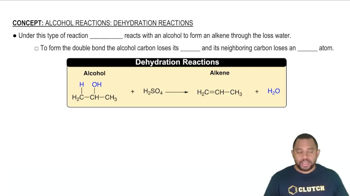
What is lost from the alcohol molecule during a dehydration reaction?
A water molecule (H2O) is lost from the alcohol during a dehydration reaction.
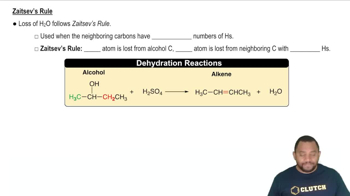
Which atom is lost from the alcohol carbon in a dehydration reaction?
The OH group is lost from the alcohol carbon.
From which neighboring carbon is the hydrogen atom lost during dehydration?
The hydrogen atom is lost from a neighboring carbon adjacent to the alcohol carbon.
What type of bond is formed between the alcohol carbon and its neighbor after dehydration?
A double bond (alkene) is formed between the alcohol carbon and its neighboring carbon.
What happens if the neighboring carbons to the alcohol carbon are identical in a dehydration reaction?
If the neighboring carbons are identical, the hydrogen can be lost from either side.
What rule is used to determine which hydrogen is lost when neighboring carbons are different?
Zaitsev's rule is used to determine which hydrogen is lost.
According to Zaitsev's rule, from which carbon is the hydrogen lost?
The hydrogen is lost from the neighboring carbon with fewer hydrogens.
Why must the alcohol carbon and its neighbor form a double bond after dehydration?
They must form a double bond to maintain four bonds for each carbon after losing OH and H.
What is the product of a dehydration reaction of an alcohol?
The product is an alkene.
What is the role of sulfuric acid in the dehydration reaction?
Sulfuric acid acts as a catalyst to promote the loss of water and formation of the alkene.
What is the significance of Zaitsev's rule in dehydration reactions?
Zaitsev's rule ensures the most substituted (stable) alkene is formed by removing H from the carbon with fewer hydrogens.
What happens to the structure of the alcohol after the loss of OH and H?
The alcohol carbon and its neighbor each lose a bond and form a double bond with each other.
In a dehydration reaction, what must be true about the number of bonds each carbon has after the reaction?
Each carbon must still have four bonds after the reaction.
When is Zaitsev's rule not needed in a dehydration reaction?
Zaitsev's rule is not needed when the neighboring carbons are identical, as the hydrogen can be lost from either side.
 뒤로뒤로
뒤로뒤로

 1:30
1:30