Skip to main content
GOB Chemistry
나의 코스
배우기
시험 준비
AI 튜터
학습 가이드
교과서적 해결책
플래시카드
탐험해 보세요
앱을 사용해 보세요
나의 코스
배우기
시험 준비
AI 튜터
학습 가이드
교과서적 해결책
플래시카드
탐험해 보세요
앱을 사용해 보세요
뒤로
Arrhenius Acid and Base quiz
카드를 뒤집기 위해 탭할 수 있습니다.
What are the two main types of acids discussed in the context of Arrhenius acids and bases?
카드를 뒤집기 위해 탭할 수 있습니다.
👆
What are the two main types of acids discussed in the context of Arrhenius acids and bases?
The two main types are binary acids and oxy acids.
진행 상황 추적
컨트롤 버튼이 '내비게이션' 모드로 변경되었습니다.
1/15
관련 플래시카드
관련 실천
추천 영상
Arrhenius Acid and Base definitions
Arrhenius Acid and Base
15 용어
Arrhenius Acid and Base
10. Acids and Bases
3 문제점
주제
Jules
Bronsted Lowry Acid and Base
10. Acids and Bases
5 문제점
주제
Jules
10. Acids and Bases - Part 1 of 3
6 주제
15 문제점
장
Jules
10. Acids and Bases - Part 2 of 3
8 주제
13 문제점
장
Jules
10. Acids and Bases - Part 3 of 3
1 주제
3 문제점
장
VideoThumbView.guidedCourse
03:11
Arrhenius Acids & Bases Concept 1
4692
views
9
rank
이 집합의 용어 (15)
하이드의 정의
What are the two main types of acids discussed in the context of Arrhenius acids and bases?
The two main types are binary acids and oxy acids.
Who developed the earliest and broadest definition of acids and bases?
Arrhenius developed the earliest and broadest definition near the end of the 19th century.
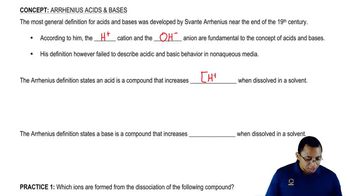
According to Arrhenius, what ion must a compound produce in water to be considered an acid?
It must increase the concentration of H+ ions in water.
What is an example of an Arrhenius acid and its dissociation in water?
HCl is an example; it dissociates into H+ and Cl- in water.
According to Arrhenius, what ion must a compound produce in water to be considered a base?
It must increase the concentration of OH- ions in water.
What is an example of an Arrhenius base and its dissociation in water?
NaOH is an example; it dissociates into Na+ and OH- in water.
What is a major limitation of the Arrhenius definition of acids and bases?
It only applies to aqueous solutions and does not account for acids or bases outside of water.
Why does the Arrhenius definition not recognize some compounds as acids or bases?
Because it requires the presence of H+ for acids and OH- for bases, excluding compounds without these ions.
Does the Arrhenius definition apply to both strong and weak acids?
Yes, as long as the compound produces H+ in water, it is considered an Arrhenius acid.
What fundamental ions did Arrhenius use to identify acids and bases?
He used the H+ cation for acids and the OH- anion for bases.
Why is the Arrhenius definition considered broad?
It was the first definition developed and includes any compound with H+ or OH-.
What must you determine to classify a compound as an Arrhenius acid, base, or neither?
You must look at the products formed when the compound dissociates in water.
What happens if a compound does not produce H+ or OH- in water according to Arrhenius?
It is classified as neither an Arrhenius acid nor base.
What is the solvent required for the Arrhenius definition to apply?
The solvent must be water (aqueous solution).
What will be discussed in later, more precise definitions of acids and bases?
Later definitions will address the limitations of Arrhenius and include compounds without H+ or OH-.
 뒤로뒤로
뒤로뒤로
 03:11
03:11