Skip to main content
GOB Chemistry
나의 코스
배우기
시험 준비
AI 튜터
학습 가이드
교과서적 해결책
플래시카드
탐험해 보세요
앱을 사용해 보세요
나의 코스
배우기
시험 준비
AI 튜터
학습 가이드
교과서적 해결책
플래시카드
탐험해 보세요
앱을 사용해 보세요
뒤로
Atomic, Ionic and Molecular Solids definitions
카드를 뒤집기 위해 탭할 수 있습니다.
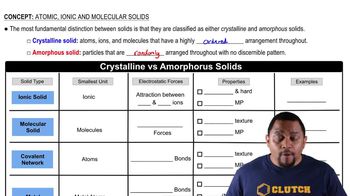
Crystalline Solid
카드를 뒤집기 위해 탭할 수 있습니다.
👆
Crystalline Solid
Structure with atoms, ions, or molecules arranged in a highly ordered, repeating pattern throughout the material.
진행 상황 추적
컨트롤 버튼이 '내비게이션' 모드로 변경되었습니다.
1/15
관련 플래시카드
관련 실천
추천 영상
Atomic, Ionic and Molecular Solids quiz
Atomic, Ionic and Molecular Solids
15 용어
Atomic, Ionic and Molecular Solids
8. Gases, Liquids and Solids
4 문제점
주제
Jules
Heating and Cooling Curves
8. Gases, Liquids and Solids
4 문제점
주제
Jules
8. Gases, Liquids and Solids - Part 1 of 2
8 주제
15 문제점
장
Jules
8. Gases, Liquids and Solids - Part 2 of 2
7 주제
15 문제점
장
Jules
VideoThumbView.guidedCourse
00:34
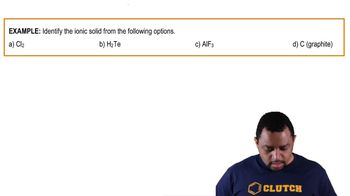
Atomic, Ionic and Molecular Solids Example 1
1610
views
7
rank
VideoThumbView.guidedCourse
04:14
Atomic, Ionic and Molecular Solids Concept 1
1904
views
7
rank
이 집합의 용어 (15)
하이드의 정의
Crystalline Solid
Structure with atoms, ions, or molecules arranged in a highly ordered, repeating pattern throughout the material.
Amorphous Solid
Material with randomly arranged particles, lacking a regular pattern and a distinct melting point, yet able to flow.
Ionic Solid
Substance composed of positive and negative ions held together by strong electrostatic attractions, typically hard and brittle.
Molecular Solid
Material made up of molecules held by intermolecular forces, generally soft with low to moderate melting points.
Covalent Network Solid
Substance where atoms are interconnected by covalent bonds, resulting in extreme hardness and very high melting points.
Metal
Elemental solid with atoms bonded by a shared electron pool, often shiny, and ranging from soft to hard textures.
Electrostatic Force
Attractive interaction between charged particles, such as ions, responsible for holding certain solids together.
Intermolecular Force
Attraction between molecules in a solid, influencing properties like texture and melting point.
Covalent Bond
Strong connection formed by the sharing of electron pairs between atoms, creating a rigid structure.
Metallic Bond
Attraction between metal atoms and a sea of delocalized electrons, giving rise to properties like luster and conductivity.
Luster
Shiny appearance characteristic of metals due to their interaction with light and electron movement.
Polymers
Large molecules composed of repeating structural units, often found in amorphous solids like plastics.
Melting Point
Temperature at which a solid transitions to a liquid; varies widely among different types of solids.
Brittleness
Tendency of a material to break or shatter without significant deformation, common in ionic solids.
Hardness
Resistance to scratching or deformation, especially notable in covalent network and ionic solids.
 뒤로뒤로
뒤로뒤로
 00:34
00:34