Skip to main content
GOB Chemistry
나의 코스
배우기
시험 준비
AI 튜터
학습 가이드
교과서적 해결책
플래시카드
탐험해 보세요
앱을 사용해 보세요
나의 코스
배우기
시험 준비
AI 튜터
학습 가이드
교과서적 해결책
플래시카드
탐험해 보세요
앱을 사용해 보세요
뒤로
Boiling Point Elevation quiz
카드를 뒤집기 위해 탭할 수 있습니다.
What happens to the boiling point of a solvent when a solute is added?
카드를 뒤집기 위해 탭할 수 있습니다.
👆
What happens to the boiling point of a solvent when a solute is added?
The boiling point of the solvent increases when a solute is added.
진행 상황 추적
컨트롤 버튼이 '내비게이션' 모드로 변경되었습니다.
1/15
관련 플래시카드
관련 실천
추천 영상
Boiling Point Elevation definitions
Boiling Point Elevation
14 용어
Boiling Point Elevation
9. Solutions
2 문제점
주제
Jules
Freezing Point Depression
9. Solutions
2 문제점
주제
Jules
9. Solutions - Part 1 of 4
5 주제
12 문제점
장
Jules
9. Solutions - Part 2 of 4
7 주제
11 문제점
장
Jules
9. Solutions - Part 3 of 4
8 주제
13 문제점
장
Jules
9. Solutions - Part 4 of 4
2 주제
2 문제점
장
VideoThumbView.guidedCourse
03:05
Boiling Point Elevation Concept 1
3595
views
4
rank
VideoThumbView.guidedCourse
01:54
Boiling Point Elevation Example 1
3612
views
2
rank
이 집합의 용어 (15)
하이드의 정의
What happens to the boiling point of a solvent when a solute is added?
The boiling point of the solvent increases when a solute is added.
What is the normal boiling point (bp) of a solvent?
The normal boiling point is the boiling point of the pure solvent before any solute is added.
How is the boiling point of a solution (bp solution) defined?
The boiling point of a solution is the boiling point of the solvent after a solute has been added.
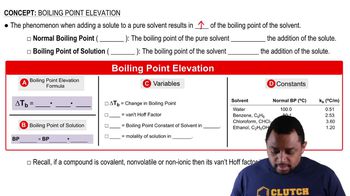
What is the formula for boiling point elevation?
The formula is Δt_b = i × k_b × m, where i is the van't Hoff factor, k_b is the boiling point constant, and m is the molality.
What does the van't Hoff factor (i) represent in the boiling point elevation formula?
The van't Hoff factor represents the number of particles the solute splits into in solution.
What is the unit for the boiling point constant (k_b)?
The unit for k_b is degrees Celsius per molality (°C/m).
How is molality (m) defined in the context of boiling point elevation?
Molality is the number of moles of solute per kilogram of solvent.
How do you calculate the boiling point of a solution using the boiling point elevation?
Add the normal boiling point of the pure solvent to the boiling point elevation (Δt_b).
Name four common solvents used in boiling point elevation problems.
Water, benzene, chloroform, and ethanol are commonly used solvents.
What happens to the boiling point of a solvent as more solute is added?
The boiling point increases as more solute is added.
What is the van't Hoff factor (i) for a non-volatile, non-ionic, or covalent compound?
For these compounds, the van't Hoff factor is 1.
Why do you not need to memorize the k_b values for common solvents?
Because these values are usually provided in questions involving colligative properties.
What is the effect of adding a solute to a solvent on the boiling point compared to the pure solvent?
The boiling point of the solution will be higher than that of the pure solvent.
What property of solutions does boiling point elevation illustrate?
Boiling point elevation is an example of a colligative property.
What is the relationship between the amount of solute and the magnitude of boiling point elevation?
The more solute added, the greater the boiling point elevation.
 뒤로뒤로
뒤로뒤로
 03:05
03:05