Skip to main content
GOB Chemistry
나의 코스
배우기
시험 준비
AI 튜터
학습 가이드
교과서적 해결책
플래시카드
탐험해 보세요
앱을 사용해 보세요
나의 코스
배우기
시험 준비
AI 튜터
학습 가이드
교과서적 해결책
플래시카드
탐험해 보세요
앱을 사용해 보세요
뒤로
Chemistry Gas Laws: Combined Gas Law quiz
카드를 뒤집기 위해 탭할 수 있습니다.
What three individual gas laws are combined to form the combined gas law?
카드를 뒤집기 위해 탭할 수 있습니다.
👆
What three individual gas laws are combined to form the combined gas law?
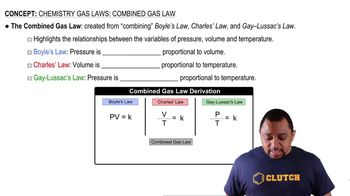
Boyle's law, Charles' law, and Gay Lussac's law are combined to form the combined gas law.
진행 상황 추적
컨트롤 버튼이 '내비게이션' 모드로 변경되었습니다.
1/15
관련 플래시카드
관련 실천
추천 영상
Chemistry Gas Laws: Combined Gas Law definitions
Chemistry Gas Laws: Combined Gas Law
14 용어
Chemistry Gas Laws: Combined Gas Law
8. Gases, Liquids and Solids
3 문제점
주제
Jules
Standard Temperature and Pressure
8. Gases, Liquids and Solids
4 문제점
주제
Jules
8. Gases, Liquids and Solids - Part 1 of 2
8 주제
15 문제점
장
Jules
8. Gases, Liquids and Solids - Part 2 of 2
7 주제
15 문제점
장
Jules
VideoThumbView.guidedCourse
03:35
Chemistry Gas Laws: Combined Gas Law Example 1
6043
views
51
rank
VideoThumbView.guidedCourse
01:43
Chemistry Gas Laws: Combined Gas Law
7113
views
49
rank
이 집합의 용어 (15)
하이드의 정의
What three individual gas laws are combined to form the combined gas law?
Boyle's law, Charles' law, and Gay Lussac's law are combined to form the combined gas law.
What variables does the combined gas law relate?
The combined gas law relates pressure, volume, and temperature.
According to Boyle's law, how are pressure and volume related?
Boyle's law states that pressure is inversely proportional to volume.
How does Charles' law relate volume and temperature?
Charles' law states that volume is directly proportional to temperature.
What is the relationship between pressure and temperature in Gay Lussac's law?
Gay Lussac's law states that pressure is directly proportional to temperature.
What is the mathematical formula for the combined gas law?
The formula is PV/T = k, where k is a constant.
How can the combined gas law be used to compare two different states of a gas?
It can be used as P1V1/T1 = P2V2/T2 to compare two sets of conditions.
In the combined gas law formula, what does the constant 'k' represent?
The constant 'k' represents a constant value for a given amount of gas.
If temperature increases and pressure remains constant, what happens to volume according to the combined gas law?
Volume increases as temperature increases if pressure is constant.
If volume decreases and temperature is constant, what happens to pressure?
Pressure increases as volume decreases if temperature is constant.
What must remain constant for the combined gas law to apply?
The amount of gas (number of moles) must remain constant.
How is the combined gas law derived from the individual gas laws?
It is derived by combining the relationships from Boyle's, Charles', and Gay Lussac's laws.
What does the numerator and denominator represent in the combined gas law formula PV/T?
Pressure and volume are in the numerator, and temperature is in the denominator.
If you know the initial and final pressure, volume, and temperature, how can you solve for an unknown variable?
You can rearrange P1V1/T1 = P2V2/T2 to solve for the unknown variable.
Why is the combined gas law useful in chemistry?
It allows you to solve problems involving changes in pressure, volume, and temperature for a fixed amount of gas.
 뒤로뒤로
뒤로뒤로
 03:35
03:35