Skip to main content
GOB Chemistry
나의 코스
배우기
시험 준비
AI 튜터
학습 가이드
교과서적 해결책
플래시카드
탐험해 보세요
앱을 사용해 보세요
나의 코스
배우기
시험 준비
AI 튜터
학습 가이드
교과서적 해결책
플래시카드
탐험해 보세요
앱을 사용해 보세요
뒤로
Covalent Bonds definitions
카드를 뒤집기 위해 탭할 수 있습니다.
Covalent Bond
카드를 뒤집기 위해 탭할 수 있습니다.
👆
Covalent Bond
A molecular connection formed by the sharing of valence electrons exclusively between nonmetal atoms.
진행 상황 추적
컨트롤 버튼이 '내비게이션' 모드로 변경되었습니다.
1/14
관련 플래시카드
관련 실천
추천 영상
Covalent Bonds quiz
Covalent Bonds
15 용어
Covalent Bonds
4. Molecular Compounds
4 문제점
주제
Jules
Naming Binary Molecular Compounds
4. Molecular Compounds
4 문제점
주제
Jules
4. Molecular Compounds - Part 1 of 3
8 주제
13 문제점
장
Jules
4. Molecular Compounds - Part 2 of 3
8 주제
14 문제점
장
Jules
4. Molecular Compounds - Part 3 of 3
1 주제
2 문제점
장
VideoThumbView.guidedCourse
01:04
Covalent Bonds Example 1
11545
views
103
rank
2
comments
VideoThumbView.guidedCourse
01:13
Covalent Bonds Example 2
4718
views
53
rank
VideoThumbView.guidedCourse
00:46
Covalent Bonds Concept 3
4897
views
18
rank
이 집합의 용어 (14)
하이드의 정의
Covalent Bond
A molecular connection formed by the sharing of valence electrons exclusively between nonmetal atoms.
Valence Electron
An outermost electron involved in chemical bonding, crucial for achieving stable electron arrangements.
Nonmetal
An element type that participates in electron sharing to form molecular bonds and achieve stability.
Octet Rule
A stability guideline where atoms aim for eight electrons in their outer shell, resembling noble gases.
Duet Rule
A stability principle for hydrogen, where two electrons in the outer shell mimic helium's configuration.
Noble Gas
An element with a naturally full outer electron shell, serving as a model for stable electron arrangements.
Electron Configuration
The specific arrangement of electrons in atomic shells, determining chemical behavior and stability.
Molecular Compound
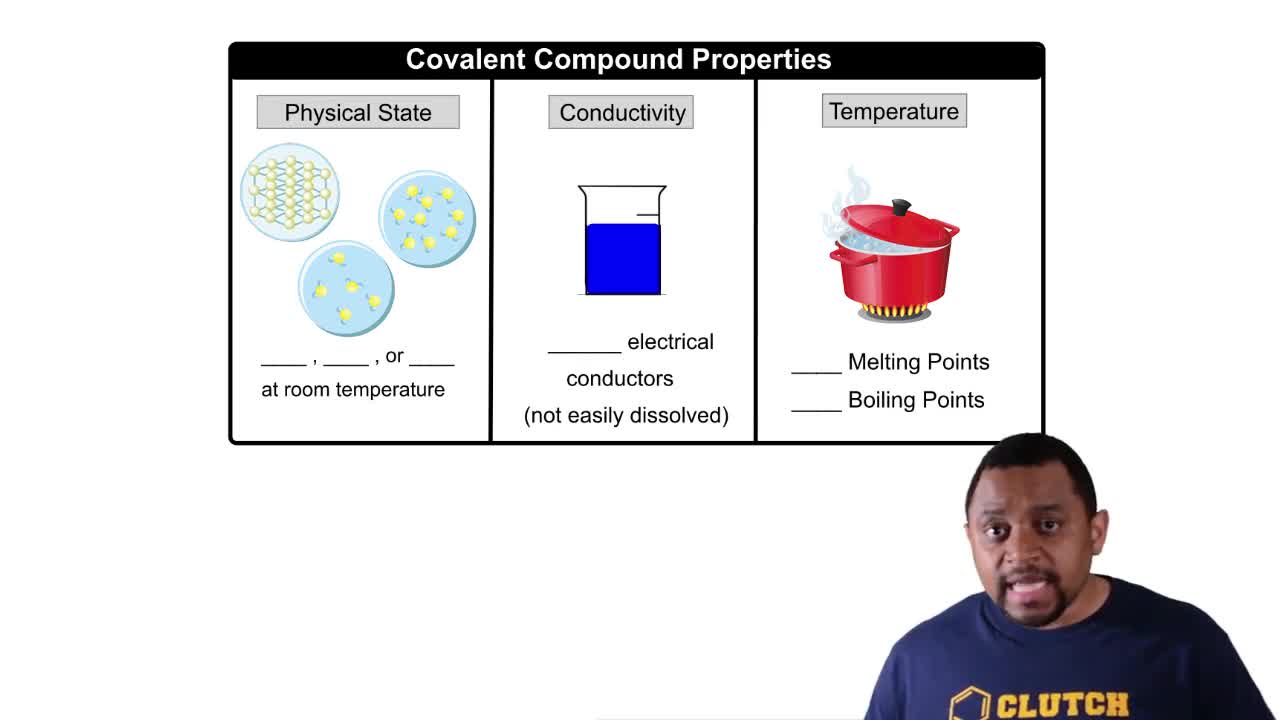
A substance formed from nonmetals sharing electrons, existing as solids, liquids, or gases at room temperature.
Melting Point
The temperature at which a solid molecular compound transitions to a liquid, typically lower for these substances.
Boiling Point
The temperature at which a molecular compound changes from liquid to gas, generally lower than in ionic compounds.
Electrical Conductivity
A property describing how poorly molecular compounds allow electric current to pass, especially in solution.
Electron Sharing
A process where atoms jointly use valence electrons to achieve stable configurations without transferring them.
Solubility
A characteristic indicating how molecular compounds do not easily dissolve in water, affecting their conductivity.
Stable Electron Arrangement
A condition where atoms have filled outer shells, often achieved by mimicking noble gases through bonding.
 뒤로뒤로
뒤로뒤로
 01:04
01:04