Skip to main content
GOB Chemistry
나의 코스
배우기
시험 준비
AI 튜터
학습 가이드
교과서적 해결책
플래시카드
탐험해 보세요
앱을 사용해 보세요
나의 코스
배우기
시험 준비
AI 튜터
학습 가이드
교과서적 해결책
플래시카드
탐험해 보세요
앱을 사용해 보세요
뒤로
Dipole Moment (Simplified) definitions
카드를 뒤집기 위해 탭할 수 있습니다.
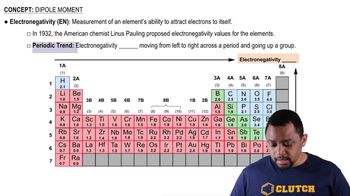
Electronegativity
카드를 뒤집기 위해 탭할 수 있습니다.
👆
Electronegativity
Measurement of an element's ability to attract electrons, increasing across a period and up a group, with fluorine as the highest.
진행 상황 추적
컨트롤 버튼이 '내비게이션' 모드로 변경되었습니다.
1/14
관련 플래시카드
관련 실천
추천 영상
Dipole Moment (Simplified) quiz
Dipole Moment (Simplified)
15 용어
Dipole Moment (Simplified)
4. Molecular Compounds
7 문제점
주제
Jules
Molecular Polarity (Simplified)
4. Molecular Compounds
5 문제점
주제
Jules
4. Molecular Compounds - Part 1 of 3
8 주제
13 문제점
장
Jules
4. Molecular Compounds - Part 2 of 3
8 주제
14 문제점
장
Jules
4. Molecular Compounds - Part 3 of 3
1 주제
2 문제점
장
VideoThumbView.guidedCourse
01:07
Dipole Moment (Simplified) Example 3
8449
views
55
rank
VideoThumbView.guidedCourse
01:51
Dipole Moment (Simplified) Concept 1
3663
views
18
rank
VideoThumbView.guidedCourse
01:25
Dipole Moment (Simplified) Concept 2
10516
views
88
rank
이 집합의 용어 (14)
하이드의 정의
Electronegativity
Measurement of an element's ability to attract electrons, increasing across a period and up a group, with fluorine as the highest.
Linus Pauling
American chemist who proposed the scale for measuring how strongly elements attract electrons in bonds.
Periodic Trend
Pattern observed in the periodic table where certain properties, like electron attraction, change predictably across periods and groups.
Fluorine
Element with the highest tendency to attract electrons, serving as a reference point for comparing other elements' electron attraction.
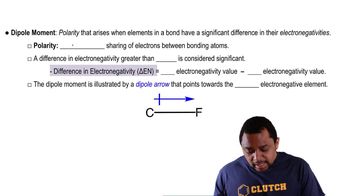
Dipole Moment
Polarity in a bond resulting from significant differences in electron attraction between bonded atoms, indicated by an arrow.
Polarity
Unequal sharing of electrons in a bond, leading to regions of partial positive and negative charge.
Dipole Arrow
Symbol used to show the direction of electron shift in a polar bond, always pointing toward the more electron-attracting atom.
Partial Charge
Slight positive or negative character on atoms in a polar bond due to unequal electron sharing.
Pure Covalent Bond
Bond where two atoms share electrons equally, resulting in no charge separation or polarity.
Nonpolar Covalent Bond
Bond with a small difference in electron attraction, causing nearly equal sharing of electrons.
Polar Covalent Bond
Bond with a moderate difference in electron attraction, resulting in partial charges and a dipole moment.
Ionic Bond
Bond formed when one atom fully transfers electrons to another, creating ions with full positive and negative charges.
Cation
Positively charged ion formed when an atom loses electrons, often seen in bonds with large electron attraction differences.
Anion
Negatively charged ion formed when an atom gains electrons, typically in highly polar or ionic bonds.
 뒤로뒤로
뒤로뒤로
 01:07
01:07