Skip to main content
GOB Chemistry
나의 코스
배우기
시험 준비
AI 튜터
학습 가이드
교과서적 해결책
플래시카드
탐험해 보세요
앱을 사용해 보세요
나의 코스
배우기
시험 준비
AI 튜터
학습 가이드
교과서적 해결책
플래시카드
탐험해 보세요
앱을 사용해 보세요
뒤로
Enzyme Regulation: Allosteric Control quiz
카드를 뒤집기 위해 탭할 수 있습니다.
What are the three main types of enzyme regulation?
카드를 뒤집기 위해 탭할 수 있습니다.
👆
What are the three main types of enzyme regulation?
The three main types are allosteric control, feedback control, and covalent modification.
진행 상황 추적
컨트롤 버튼이 '내비게이션' 모드로 변경되었습니다.
1/15
관련 플래시카드
관련 실천
추천 영상
Enzyme Regulation: Allosteric Control definitions
Enzyme Regulation: Allosteric Control
12 용어
Enzyme Regulation: Allosteric Control
19. Enzymes
1 문제
주제
Laura
Enzyme Regulation: Feedback Control
19. Enzymes
1 문제
주제
Laura
19. Enzymes
9 주제
15 문제점
장
Laura
VideoThumbView.guidedCourse
1:21
Allosteric Control Example 1
2946
views
1
rank
VideoThumbView.guidedCourse
2:57
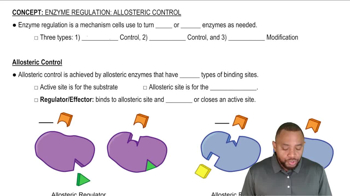
Allosteric Control Concept 1
2743
views
2
rank
이 집합의 용어 (15)
하이드의 정의
What are the three main types of enzyme regulation?
The three main types are allosteric control, feedback control, and covalent modification.
What is the function of the active site on an enzyme?
The active site is where the substrate attaches to the enzyme.
What is the allosteric site on an enzyme?
The allosteric site is a location on the enzyme where a regulator (effector) binds.
What happens when a positive allosteric regulator binds to an enzyme?
It opens up an active site, increasing the rate of reaction by allowing substrate attachment.
How does a negative allosteric regulator affect enzyme activity?
It closes or hides the active site, decreasing the rate of reaction by preventing substrate attachment.
What is another name for a regulator in allosteric control?
A regulator is also called an effector.
How do allosteric enzymes differ from other enzymes?
Allosteric enzymes have both an active site and an allosteric site for regulator binding.
What is the effect of a regulator binding to the allosteric site?
It can either enhance or inhibit the enzyme's activity by modifying the accessibility of the active site.
What does a positive allosteric regulator do to the rate of reaction?
It increases the rate of reaction.
What does a negative allosteric regulator do to the rate of reaction?
It decreases the rate of reaction.
Where does the substrate bind on an enzyme?
The substrate binds at the active site.
What is the main purpose of enzyme regulation in cells?
It allows cells to turn enzymes on or off as needed.
What happens to the active site when a negative regulator binds to the allosteric site?
The active site becomes unavailable for substrate attachment.
What is the abbreviation commonly used for substrate in enzyme diagrams?
The substrate is commonly abbreviated as 'S'.
How does allosteric control help manage enzyme activity?
It manages enzyme activity by using regulators that bind to the allosteric site to open or close the active site.
 뒤로뒤로
뒤로뒤로
 1:21
1:21