Skip to main content
GOB Chemistry
나의 코스
배우기
시험 준비
AI 튜터
학습 가이드
교과서적 해결책
플래시카드
탐험해 보세요
앱을 사용해 보세요
나의 코스
배우기
시험 준비
AI 튜터
학습 가이드
교과서적 해결책
플래시카드
탐험해 보세요
앱을 사용해 보세요
뒤로
Factors Affecting Enzyme Activity quiz
카드를 뒤집기 위해 탭할 수 있습니다.
What is enzyme activity?
카드를 뒤집기 위해 탭할 수 있습니다.
👆
What is enzyme activity?
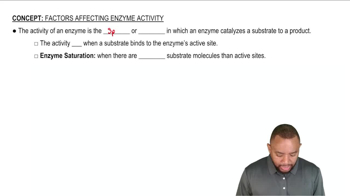
Enzyme activity is the rate at which an enzyme catalyzes a substrate into a product.
진행 상황 추적
컨트롤 버튼이 '내비게이션' 모드로 변경되었습니다.
1/15
관련 플래시카드
관련 실천
추천 영상
Factors Affecting Enzyme Activity definitions
Factors Affecting Enzyme Activity
13 용어
Factors Affecting Enzyme Activity
19. Enzymes
7 문제점
주제
Laura
Enzyme Inhibition
19. Enzymes
7 문제점
주제
Laura
19. Enzymes
9 주제
15 문제점
장
Laura
VideoThumbView.guidedCourse
5:33
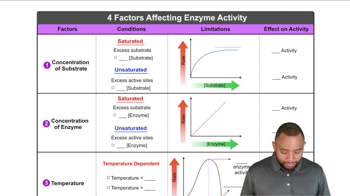
Factors Affecting Enzyme Activity Concept 2
1995
views
2
rank
VideoThumbView.guidedCourse
1:06
Factors Affecting Enzyme Activity Concept 1
1941
views
2
rank
VideoThumbView.guidedCourse
1:31
Factors Affecting Enzyme Activity Example 1
1908
views
1
rank
이 집합의 용어 (15)
하이드의 정의
What is enzyme activity?
Enzyme activity is the rate at which an enzyme catalyzes a substrate into a product.
What happens to enzyme activity as substrate concentration increases before saturation?
Enzyme activity increases as substrate concentration increases, as more substrates bind to available active sites.
What is enzyme saturation?
Enzyme saturation occurs when all enzyme active sites are occupied by substrates, and adding more substrate does not increase activity.
How does adding more substrate affect enzyme activity after saturation is reached?
After saturation, adding more substrate does not increase enzyme activity because all active sites are already occupied.
How does enzyme concentration affect activity in a saturated environment?
In a saturated environment, increasing enzyme concentration increases activity by providing more active sites for substrates.
What happens if you add more enzyme in an unsaturated environment?
Adding more enzyme in an unsaturated environment does not increase activity because there are already excess active sites with not enough substrate.
How does temperature affect enzyme activity?
Enzyme activity increases with temperature up to an optimal point, then decreases as the enzyme denatures at higher temperatures.
What is the optimal temperature for most enzymes?
The optimal temperature for most enzymes is around 37°C.
What happens to enzyme activity above 50°C?
Above 50°C, enzyme activity decreases because the enzyme denatures and loses its functional structure.
How does pH affect enzyme activity?
Each enzyme has an optimal pH range, and activity decreases outside this range; extreme pH values can denature the enzyme.
What is the optimal pH for pepsin?
The optimal pH for pepsin is 1.7, and it can function effectively between pH 0.7 and 2.7.
What is the optimal pH for amylase?
The optimal pH for amylase is 6.8, which is close to neutral.
What is denaturation in the context of enzymes?
Denaturation is the unfolding of an enzyme's 3D structure, which disrupts its function.
Which four main factors affect enzyme activity?
The four main factors are substrate concentration, enzyme concentration, temperature, and pH.
Why does enzyme activity decrease when the enzyme is denatured?
Enzyme activity decreases because denaturation disrupts the enzyme's structure, preventing it from functioning properly.
 뒤로뒤로
뒤로뒤로
 5:33
5:33