Skip to main content
GOB Chemistry
나의 코스
배우기
시험 준비
AI 튜터
학습 가이드
교과서적 해결책
플래시카드
탐험해 보세요
앱을 사용해 보세요
나의 코스
배우기
시험 준비
AI 튜터
학습 가이드
교과서적 해결책
플래시카드
탐험해 보세요
앱을 사용해 보세요
뒤로
Gas Evolution Equations (Simplified) quiz
카드를 뒤집기 위해 탭할 수 있습니다.
What is a gas evolution equation?
카드를 뒤집기 위해 탭할 수 있습니다.
👆
What is a gas evolution equation?
A gas evolution equation is a molecular equation that involves the creation of a gas, such as carbon dioxide, from a chemical reaction.
진행 상황 추적
컨트롤 버튼이 '내비게이션' 모드로 변경되었습니다.
1/15
관련 플래시카드
관련 실천
추천 영상
Gas Evolution Equations (Simplified) definitions
Gas Evolution Equations (Simplified)
12 용어
Gas Evolution Equations (Simplified)
10. Acids and Bases
3 문제점
주제
Jules
Ionic Salts (Simplified)
10. Acids and Bases
5 문제점
주제
10. Acids and Bases - Part 1 of 3
6 주제
15 문제점
장
Jules
10. Acids and Bases - Part 2 of 3
8 주제
13 문제점
장
Jules
10. Acids and Bases - Part 3 of 3
1 주제
3 문제점
장
VideoThumbView.guidedCourse
01:33
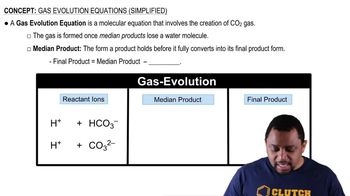
Gas Evolution Equations (Simplified) Concept 1
3042
views
11
rank
VideoThumbView.guidedCourse
03:17
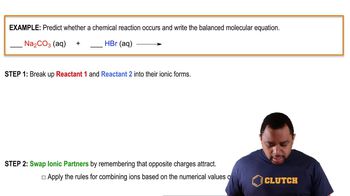
Gas Evolution Equations (Simplified) Example 1
6680
views
28
rank
이 집합의 용어 (15)
하이드의 정의
What is a gas evolution equation?
A gas evolution equation is a molecular equation that involves the creation of a gas, such as carbon dioxide, from a chemical reaction.
What is a medium product in a gas evolution equation?
A medium product is an intermediate form that is produced before it fully converts into the final product by losing a water molecule.
Which ions are key reactants in gas evolution equations involving CO2?
The key reactant ions are H+ (hydrogen ion) and the bicarbonate ion.
What is formed when H+ reacts with bicarbonate ion?
When H+ reacts with bicarbonate ion, carbonic acid (H2CO3) is formed as the median product.
Why can't carbonic acid be held as a product in these reactions?
Carbonic acid is unstable and automatically decomposes by losing water to form CO2 gas.
What are the final products when carbonic acid loses water?
The final products are carbon dioxide gas (CO2) and liquid water (H2O).
What happens to the water molecule when carbonic acid decomposes?
The water molecule is released as a liquid while CO2 is released as a gas.
What is the general process for forming CO2 in a gas evolution equation?
The process involves forming carbonic acid as a median product, which then loses water to produce CO2 gas.
What is the chemical formula for carbonic acid?
The chemical formula for carbonic acid is H2CO3.
What is the role of H+ in gas evolution equations?
H+ reacts with bicarbonate or carbonate ions to form carbonic acid, which then decomposes to CO2 and water.
What happens if H+ reacts with carbonate ion instead of bicarbonate?
It still forms carbonic acid as a median product, which then decomposes to CO2 and water.
Why is CO2 considered the final product in these reactions?
CO2 is the final product because it is formed after the median product loses water and cannot revert back.
What physical states are CO2 and H2O in after the reaction?
CO2 is in the gas state and H2O is in the liquid state.
How does the loss of water relate to the formation of gas in these equations?
The loss of water from the median product (carbonic acid) results in the evolution of CO2 gas.
What is the significance of the median product in gas evolution equations?
The median product is crucial because its decomposition by losing water leads to the formation of the gaseous final product.
 뒤로뒤로
뒤로뒤로
 01:33
01:33