Skip to main content
GOB Chemistry
나의 코스
배우기
시험 준비
AI 튜터
학습 가이드
교과서적 해결책
플래시카드
탐험해 보세요
앱을 사용해 보세요
나의 코스
배우기
시험 준비
AI 튜터
학습 가이드
교과서적 해결책
플래시카드
탐험해 보세요
앱을 사용해 보세요
뒤로
Gas Stoichiometry quiz
카드를 뒤집기 위해 탭할 수 있습니다.
What does gas stoichiometry involve?
카드를 뒤집기 위해 탭할 수 있습니다.
👆
What does gas stoichiometry involve?
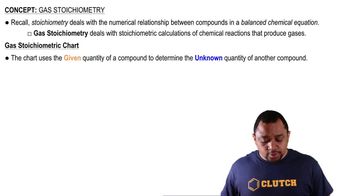
Gas stoichiometry involves stoichiometric calculations in chemical reactions that produce gases.
진행 상황 추적
컨트롤 버튼이 '내비게이션' 모드로 변경되었습니다.
1/15
관련 플래시카드
관련 실천
추천 영상
Gas Stoichiometry definitions
Gas Stoichiometry
15 용어
Gas Stoichiometry
8. Gases, Liquids and Solids
2 문제점
주제
Jules
Intermolecular Forces (Simplified)
8. Gases, Liquids and Solids
6 문제점
주제
Jules
8. Gases, Liquids and Solids - Part 1 of 2
8 주제
15 문제점
장
Jules
8. Gases, Liquids and Solids - Part 2 of 2
7 주제
15 문제점
장
Jules
VideoThumbView.guidedCourse
02:05
Gas Stoichiometry Concept 2
6131
views
21
rank
VideoThumbView.guidedCourse
00:47
Gas Stoichiometry Concept 1
6836
views
21
rank
VideoThumbView.guidedCourse
03:51
Gas Stoichiometry Example 1
6294
views
26
rank
이 집합의 용어 (15)
하이드의 정의
What does gas stoichiometry involve?
Gas stoichiometry involves stoichiometric calculations in chemical reactions that produce gases.
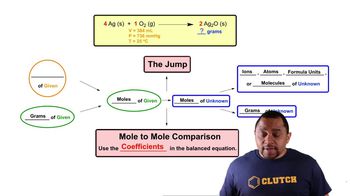
What is the purpose of the stoichiometric chart in gas stoichiometry?
The stoichiometric chart helps convert given quantities of a compound to determine unknown quantities in a balanced chemical equation.
Which law is used to calculate moles of a gas from its volume, pressure, and temperature?
The ideal gas law (PV = nRT) is used to calculate moles of a gas.
How do you calculate moles of a gas using the ideal gas law?
Moles are calculated as n = PV/(RT), where P is pressure, V is volume, R is the gas constant, and T is temperature.
What information is needed to use the ideal gas law for stoichiometric calculations?
You need the gas's pressure, volume, and temperature.
What is the 'jump' in stoichiometric calculations?
The 'jump' refers to moving from known (given) information to unknown information using mole-to-mole comparisons.
How do you convert grams of a compound to moles in stoichiometry?
Divide the grams by the compound's molar mass to get moles.
What is the next step after finding moles of the given compound?
Use the balanced equation's coefficients to convert moles of given to moles of unknown.
How are balanced equation coefficients used in gas stoichiometry?
They are used for mole-to-mole comparisons between compounds.
What can moles of the unknown compound be converted into?
Moles of unknown can be converted into grams, molecules, atoms, ions, or formula units.
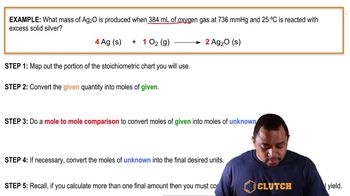
What reaction example is used in the lesson for gas stoichiometry?
The reaction of silver solid and oxygen gas to produce silver oxide is used.
What is the stoichiometric ratio of silver to oxygen in the example reaction?
4 moles of silver react with 1 mole of oxygen gas.
What is the product formed in the example reaction?
The product is silver oxide solid.
Why is it important to review foundational stoichiometry videos before studying gas stoichiometry?
Reviewing foundational videos helps understand the stoichiometric chart and its modifications for gas stoichiometry.
What is the main modification to the stoichiometric chart for gas stoichiometry?
The main modification is incorporating the ideal gas law to find moles from gas properties.
 뒤로뒤로
뒤로뒤로
 02:05
02:05