GOB Chemistry
나의 코스
배우기
시험 준비
AI 튜터
학습 가이드
교과서적 해결책
플래시카드
탐험해 보세요
앱을 사용해 보세요
나의 코스
배우기
시험 준비
AI 튜터
학습 가이드
교과서적 해결책
플래시카드
탐험해 보세요
앱을 사용해 보세요
뒤로
Heat Capacity quiz
카드를 뒤집기 위해 탭할 수 있습니다.
What is the relationship between the amount of heat applied to a substance and its temperature change?
카드를 뒤집기 위해 탭할 수 있습니다.
👆
What is the relationship between the amount of heat applied to a substance and its temperature change?
The amount of heat applied is directly proportional to the temperature change of the substance.
진행 상황 추적
컨트롤 버튼이 '내비게이션' 모드로 변경되었습니다.
1/15
관련 플래시카드
관련 실천
추천 영상
Heat Capacity definitions
Heat Capacity
13 용어
Heat Capacity quiz
Heat Capacity
15 용어
Heat Capacity
7. Energy, Rate and Equilibrium
6 문제점
주제

Jules
7. Energy, Rate and Equilibrium - Part 1 of 3
5 주제
11 문제점
장
Jules
7. Energy, Rate and Equilibrium - Part 2 of 3
5 주제
11 문제점
장
Jules
7. Energy, Rate and Equilibrium - Part 3 of 3
3 주제
8 문제점
장
Jules
VideoThumbView.guidedCourse
00:44
Heat Capacity
9883
views
56
rank
VideoThumbView.guidedCourse
02:08
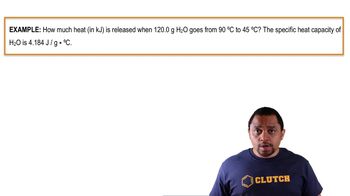
Heat Capacity Example 3
9126
views
67
rank
1
comments
VideoThumbView.guidedCourse
01:47
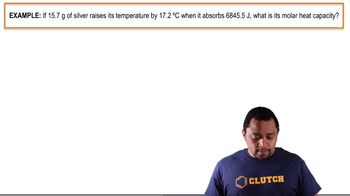
Heat Capacity Example 2
9485
views
77
rank
이 집합의 용어 (15)
하이드의 정의
What is the relationship between the amount of heat applied to a substance and its temperature change?
The amount of heat applied is directly proportional to the temperature change of the substance.
How is heat capacity (C) defined?
Heat capacity is the amount of heat required to change the temperature of a substance.
What does specific heat capacity (c) measure?
Specific heat capacity measures the heat required to change the temperature of 1 gram of a substance by 1 degree (Kelvin or Celsius).
What is the formula for specific heat capacity?
The formula is c = Q / (m * ΔT), where Q is heat, m is mass in grams, and ΔT is the temperature change.
What does molar heat capacity (C) refer to?
Molar heat capacity is the amount of heat required to change the temperature of 1 mole of a substance by 1 degree (Kelvin or Celsius).
What is the formula for molar heat capacity?
The formula is C = Q / (n * ΔT), where Q is heat, n is moles, and ΔT is the temperature change.
What units are used for specific heat capacity?
Specific heat capacity is measured in joules per gram per degree Celsius (J/g·°C) or joules per gram per Kelvin (J/g·K).
What units are used for molar heat capacity?
Molar heat capacity is measured in joules per mole per degree Celsius (J/mol·°C) or joules per mole per Kelvin (J/mol·K).
Why must the units of temperature in calculations match the units in heat capacity values?
Because using mismatched units can lead to incorrect calculations of heat absorbed or released.
What is the rearranged formula to solve for the amount of heat absorbed or released?
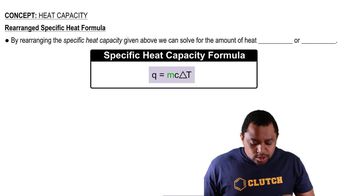
The formula is Q = m * c * ΔT, also known as 'mcat.'
What does the mnemonic 'mcat' stand for in the context of heat capacity?
'mcat' stands for Q = m * c * ΔT, relating mass, specific heat, and temperature change to heat.
In the formula Q = m * c * ΔT, what does each variable represent?
Q is heat, m is mass in grams, c is specific heat capacity, and ΔT is the temperature change.
How do you determine whether to use Celsius or Kelvin in heat capacity calculations?
You use the temperature unit that matches the units in your specific or molar heat capacity value.
What is the main difference between specific heat capacity and molar heat capacity?
Specific heat capacity is per gram, while molar heat capacity is per mole of substance.
What does Q represent in all heat capacity formulas?
Q represents the amount of heat absorbed or released.