GOB Chemistry
나의 코스
배우기
시험 준비
AI 튜터
학습 가이드
교과서적 해결책
플래시카드
탐험해 보세요
앱을 사용해 보세요
나의 코스
배우기
시험 준비
AI 튜터
학습 가이드
교과서적 해결책
플래시카드
탐험해 보세요
앱을 사용해 보세요
뒤로
Hess's Law quiz
카드를 뒤집기 위해 탭할 수 있습니다.
What does Hess's law allow you to do with thermochemical equations?
카드를 뒤집기 위해 탭할 수 있습니다.
👆
What does Hess's law allow you to do with thermochemical equations?
Hess's law allows you to rearrange thermochemical equations to calculate the overall enthalpy of reaction.
진행 상황 추적
컨트롤 버튼이 '내비게이션' 모드로 변경되었습니다.
1/15
관련 플래시카드
관련 실천
추천 영상
Hess's Law definitions
Hess's Law
15 용어
Rate of Reaction
7. Energy, Rate and Equilibrium
5 문제점
주제

Jules
7. Energy, Rate and Equilibrium - Part 1 of 3
5 주제
11 문제점
장
Jules
7. Energy, Rate and Equilibrium - Part 2 of 3
5 주제
11 문제점
장
Jules
7. Energy, Rate and Equilibrium - Part 3 of 3
3 주제
8 문제점
장
Jules
VideoThumbView.guidedCourse
02:03
Hess's Law
7610
views
37
rank
VideoThumbView.guidedCourse
03:11
Hess's Law
9287
views
63
rank
VideoThumbView.guidedCourse
01:39
Hess's Law Example 1
7775
views
42
rank
이 집합의 용어 (15)
하이드의 정의
What does Hess's law allow you to do with thermochemical equations?
Hess's law allows you to rearrange thermochemical equations to calculate the overall enthalpy of reaction.
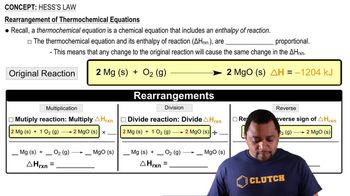
How does multiplying a thermochemical equation by a number affect its enthalpy of reaction (ΔH)?
Multiplying the equation by a number multiplies the enthalpy of reaction (ΔH) by the same number.
What happens to ΔH if you divide a thermochemical equation by 2?
Dividing the equation by 2 also divides the enthalpy of reaction (ΔH) by 2.
How does reversing a thermochemical equation affect the sign of ΔH?
Reversing the equation reverses the sign of ΔH; a negative value becomes positive and vice versa.
What is a thermochemical equation?
A thermochemical equation is a chemical equation that includes the enthalpy of reaction (ΔH).
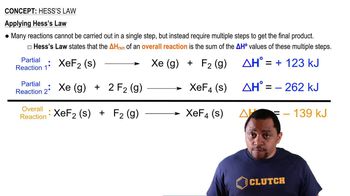
What does Hess's law state about the enthalpy of multi-step reactions?
Hess's law states that the overall enthalpy of reaction is the sum of the enthalpies of the individual steps.
What are reaction intermediates in the context of Hess's law?
Reaction intermediates are substances that appear on both sides of partial reactions and cancel each other out.
How do you find the overall enthalpy change for a reaction using Hess's law?
You add and subtract the enthalpy changes (ΔH) of the partial reactions to find the overall enthalpy change.
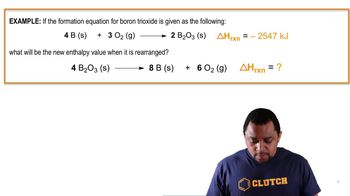
If you reverse a reaction with ΔH = -1204 kJ, what is the new ΔH?
The new ΔH is +1204 kJ after reversing the reaction.
Why do reaction intermediates cancel out in Hess's law calculations?
They cancel out because they appear as both reactants and products, so they do not affect the overall reaction.
What must you do to ΔH if you multiply the coefficients in a thermochemical equation by 2?
You must also multiply ΔH by 2.
What is the relationship between changes to a thermochemical equation and its ΔH?
Any change to the equation causes the same change to ΔH.
How do you handle substances that appear on both sides of partial reactions when using Hess's law?
You cancel them out to simplify the calculation of the overall reaction.
What is the purpose of rearranging thermochemical equations in Hess's law problems?
The purpose is to determine the overall reaction and its associated enthalpy change.
In the example with xenon difluoride and fluorine, how is the overall ΔH calculated?
The overall ΔH is calculated by adding and subtracting the ΔH values of the partial reactions, resulting in the final ΔH.