Skip to main content
GOB Chemistry
나의 코스
배우기
시험 준비
AI 튜터
학습 가이드
교과서적 해결책
플래시카드
탐험해 보세요
앱을 사용해 보세요
나의 코스
배우기
시험 준비
AI 튜터
학습 가이드
교과서적 해결책
플래시카드
탐험해 보세요
앱을 사용해 보세요
뒤로
Intro to Gluconeogenesis quiz
카드를 뒤집기 위해 탭할 수 있습니다.
What is gluconeogenesis?
카드를 뒤집기 위해 탭할 수 있습니다.
👆
What is gluconeogenesis?
Gluconeogenesis is the synthesis of glucose from non-carbohydrate sources, especially when blood glucose is low.
진행 상황 추적
컨트롤 버튼이 '내비게이션' 모드로 변경되었습니다.
1/15
관련 플래시카드
관련 실천
추천 영상
Intro to Gluconeogenesis definitions
Intro to Gluconeogenesis
14 용어
Intro to Gluconeogenesis
22. Carbohydrate Metabolism
2 문제점
주제
Nicole
Gluconeogenesis
22. Carbohydrate Metabolism
5 문제점
주제
Nicole
22. Carbohydrate Metabolism
9 주제
15 문제점
장
Nicole
VideoThumbView.guidedCourse
1:31
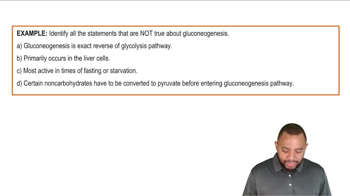
Intro to Gluconeogenesis Example 1
1266
views
2
rank
VideoThumbView.guidedCourse
1:45
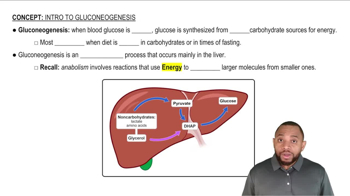
Intro to Gluconeogenesis Concept 1
1328
views
VideoThumbView.guidedCourse
1:03
Intro to Gluconeogenesis Concept 2
1303
views
이 집합의 용어 (15)
하이드의 정의
What is gluconeogenesis?
Gluconeogenesis is the synthesis of glucose from non-carbohydrate sources, especially when blood glucose is low.
When is gluconeogenesis most active?
It is most active when dietary carbohydrates are low or during fasting.
Why is gluconeogenesis important for the brain?
Because glucose is the primary energy source for the brain, especially when dietary intake is insufficient.
Where does gluconeogenesis primarily occur?
Gluconeogenesis mainly occurs in the liver.
Is gluconeogenesis an anabolic or catabolic process?
It is an anabolic process, meaning it uses energy to build larger molecules from smaller ones.
What are two main non-carbohydrate sources for gluconeogenesis?
Lactate and amino acids are two main non-carbohydrate sources.
How are lactate and amino acids used in gluconeogenesis?
They are converted into pyruvate, which can then be transformed into DHAP and eventually into glucose.
What is DHAP and its role in gluconeogenesis?
DHAP stands for dihydroxyacetone phosphate and is an intermediate that can be converted into glucose.
How does glycerol contribute to gluconeogenesis?
Glycerol is converted into DHAP, which then helps in the synthesis of glucose.
What are the two ways the body can obtain glucose?
The body can obtain glucose by eating carbohydrates or by synthesizing it through gluconeogenesis.
How is gluconeogenesis related to glycolysis?
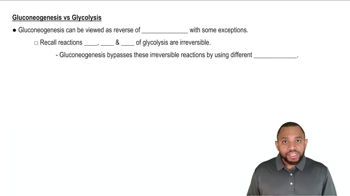
Gluconeogenesis is essentially the reverse of glycolysis, but it bypasses certain irreversible steps.
What are the irreversible reactions in glycolysis?
Reactions 1, 3, and 10 in glycolysis are irreversible.
How does gluconeogenesis bypass irreversible glycolysis steps?
It uses different enzymes to bypass the irreversible reactions.
When are gluconeogenesis-specific enzymes upregulated?
These enzymes are upregulated when blood glucose levels are low.
What is the main purpose of gluconeogenesis during fasting?
Its main purpose is to maintain adequate glucose levels for energy, especially for the brain.
 뒤로뒤로
뒤로뒤로
 1:31
1:31