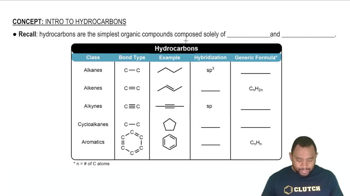
Hydrocarbons are composed solely of carbon and hydrogen atoms.
What is the generic formula for alkanes?
The generic formula for alkanes is CnH2n+2, where n is the number of carbon atoms.
How are the carbon atoms in alkanes bonded?
In alkanes, carbon atoms are bonded to each other by single bonds.
What is the hybridization of carbon atoms in alkanes?
Carbon atoms in alkanes are sp3 hybridized because they are connected to four surrounding atoms.
What is the generic formula for alkenes?
The generic formula for alkenes is CnH2n, reflecting the presence of a double bond.
How does the number of hydrogens change when a double bond is added to a hydrocarbon?
Adding a double bond causes each double-bonded carbon to lose one hydrogen, reducing the total hydrogen count.
What is the hybridization of carbon atoms in alkenes?
Carbon atoms in alkenes are sp2 hybridized because they are connected to three surrounding atoms.
What is the generic formula for alkynes?
The generic formula for alkynes is CnH2n-2, due to the presence of a triple bond.
What is the hybridization of carbon atoms in alkynes?
Carbon atoms in alkynes are sp hybridized, as they are connected to two surrounding atoms.
What is a cycloalkane and its generic formula?
Cycloalkanes are ring structures with only single bonds, and their generic formula is CnH2n.
How does the formula for cycloalkanes compare to alkenes?
Cycloalkanes have the same generic formula as alkenes, CnH2n, because forming a ring requires losing two hydrogens.
What is the structure and formula of benzene?
Benzene is an aromatic hydrocarbon with six carbons in a ring and alternating double bonds, with the formula C6H6.
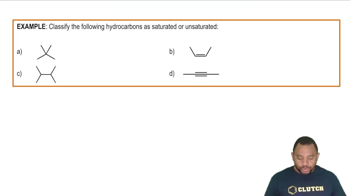
What is the difference between saturated and unsaturated hydrocarbons?
Saturated hydrocarbons have only single bonds and maximum hydrogen atoms, while unsaturated hydrocarbons have double or triple bonds, reducing hydrogen count.
Can carbon-carbon single bonds in alkanes rotate freely?
Yes, carbon-carbon single bonds in alkanes can rotate freely, affecting molecular conformation.
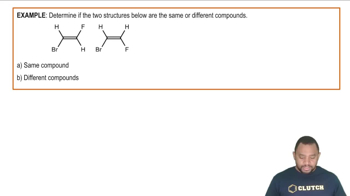
Why can't double bonds in alkenes rotate freely?
Double bonds in alkenes restrict rotation, leading to fixed spatial orientations and potentially different compounds.