Skip to main content
GOB Chemistry
나의 코스
배우기
시험 준비
AI 튜터
학습 가이드
교과서적 해결책
플래시카드
탐험해 보세요
앱을 사용해 보세요
나의 코스
배우기
시험 준비
AI 튜터
학습 가이드
교과서적 해결책
플래시카드
탐험해 보세요
앱을 사용해 보세요
뒤로
Kinetic Molecular Theory definitions
카드를 뒤집기 위해 탭할 수 있습니다.
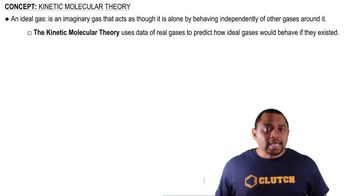
Ideal Gas
카드를 뒤집기 위해 탭할 수 있습니다.
👆
Ideal Gas
A theoretical substance imagined to behave independently, unaffected by other gases, and used to model real gas behavior.
진행 상황 추적
컨트롤 버튼이 '내비게이션' 모드로 변경되었습니다.
1/15
관련 플래시카드
관련 실천
추천 영상
Kinetic Molecular Theory quiz
Kinetic Molecular Theory
15 용어
Kinetic Molecular Theory
8. Gases, Liquids and Solids
4 문제점
주제
Jules
The Ideal Gas Law
8. Gases, Liquids and Solids
4 문제점
주제
Jules
8. Gases, Liquids and Solids - Part 1 of 2
8 주제
15 문제점
장
Jules
8. Gases, Liquids and Solids - Part 2 of 2
7 주제
15 문제점
장
Jules
VideoThumbView.guidedCourse
02:13
Kinetic Molecular Theory Example 1
5752
views
29
rank
VideoThumbView.guidedCourse
01:19
Kinetic Molecular Theory Concept 1
6312
views
38
rank
VideoThumbView.guidedCourse
03:23
Kinetic Molecular Theory Concept 2
6255
views
33
rank
이 집합의 용어 (15)
하이드의 정의
Ideal Gas
A theoretical substance imagined to behave independently, unaffected by other gases, and used to model real gas behavior.
Kinetic Molecular Theory
A framework using real gas data to predict the properties and behavior of an imaginary, perfectly behaving gas.
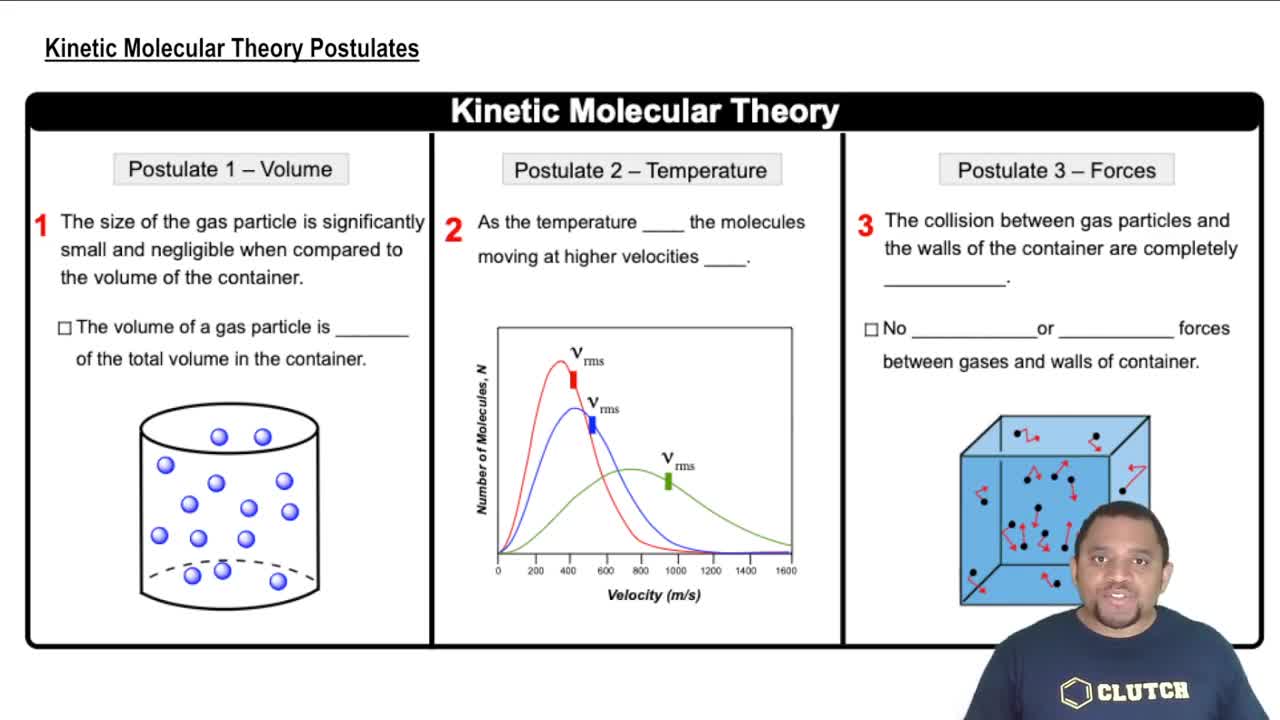
Postulate 1
A principle stating that the size of each particle is so small compared to the container that its volume is negligible.
Postulate 2
A principle describing how increased temperature leads to higher velocities for gas molecules.
Postulate 3
A principle stating that collisions between particles and container walls are perfectly elastic, with no energy loss.
Elastic Collision
An interaction where particles bounce off each other or walls without any attractive or repulsive forces or energy loss.
Root Mean Square Speed
A statistical measure representing the average velocity of gas molecules at a given temperature.
Gas Molecule
A tiny particle that moves rapidly and randomly, occupying a negligible fraction of the container's volume.
Container Volume
The total space available for gas particles, vastly larger than the combined size of all particles inside.
Temperature
A physical quantity that directly influences the average speed and kinetic energy of gas particles.
Velocity
The speed and direction at which a gas particle moves, increasing with higher temperature.
Attractive Forces
Interactions that would cause particles to stick together, assumed absent in the ideal gas model.
Repulsive Forces
Interactions that would push particles apart, considered nonexistent in the context of ideal gases.
Stoichiometry
The calculation of quantitative relationships in chemical reactions, often involving gas laws.
Imaginary Gas
A conceptual substance used for theoretical modeling, not found in reality but useful for predictions.
 뒤로뒤로
뒤로뒤로
 02:13
02:13