Skip to main content
GOB Chemistry
나의 코스
배우기
시험 준비
AI 튜터
학습 가이드
교과서적 해결책
플래시카드
탐험해 보세요
앱을 사용해 보세요
나의 코스
배우기
시험 준비
AI 튜터
학습 가이드
교과서적 해결책
플래시카드
탐험해 보세요
앱을 사용해 보세요
뒤로
Naming Amides quiz
카드를 뒤집기 위해 탭할 수 있습니다.
What functional groups characterize an amide?
카드를 뒤집기 위해 탭할 수 있습니다.
👆
What functional groups characterize an amide?
An amide is characterized by a carbonyl group connected to a nitrogen atom.
진행 상황 추적
컨트롤 버튼이 '내비게이션' 모드로 변경되었습니다.
1/15
관련 플래시카드
관련 실천
추천 영상
Naming Amides definitions
Naming Amides
13 용어
Naming Amides
16. Carboxylic Acids and Their Derivatives
6 문제점
주제
Jules
Carboxylic Acid Reactions
16. Carboxylic Acids and Their Derivatives
5 문제점
주제
Ernest
16. Carboxylic Acids and Their Derivatives - Part 1 of 2
4 주제
8 문제점
장
Jules
16. Carboxylic Acids and Their Derivatives - Part 2 of 2
5 주제
8 문제점
장
Jules
VideoThumbView.guidedCourse
2:03
IUPAC Rules for Naming Amides Example 2
1954
views
2
rank
VideoThumbView.guidedCourse
0:59
Intro to Amides Concept 1
2286
views
2
rank
VideoThumbView.guidedCourse
0:35
IUPAC Rules for Naming Amides Concept 2
2065
views
1
rank
이 집합의 용어 (15)
하이드의 정의
What functional groups characterize an amide?
An amide is characterized by a carbonyl group connected to a nitrogen atom.
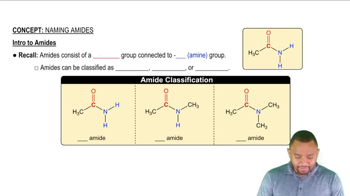
How are amides classified as primary, secondary, or tertiary?
Amides are classified based on the number of carbons directly attached to the nitrogen: one for primary, two for secondary, and three for tertiary.
What is a primary amide?
A primary amide has only one carbon directly attached to the nitrogen atom.
How many carbons are attached to the nitrogen in a secondary amide?
A secondary amide has two carbons directly attached to the nitrogen.
What defines a tertiary amide?
A tertiary amide has three carbons directly attached to the nitrogen atom.
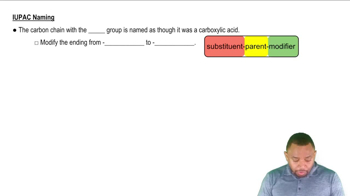
In IUPAC naming, how is the parent chain of an amide determined?
The parent chain is the carbon chain containing the carbonyl group, named as if it were a carboxylic acid.
How is the ending of a carboxylic acid name changed to form an amide name in IUPAC?
The ending 'oic acid' is replaced with 'amide' in the IUPAC name.
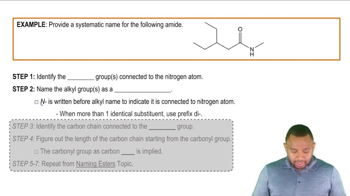
How are substituents on the nitrogen atom indicated in IUPAC amide names?
Substituents on the nitrogen are included in the name and are prefixed with 'N-'.
What is the main difference between IUPAC and common naming of amides?
IUPAC uses systematic parent chain names, while common naming uses common prefixes for the parent chain.
How are substituents on nitrogen listed in common naming of amides?
They are listed alphabetically and each is prefixed with 'N-'.
What is the common name prefix for a three-carbon amide parent chain?
The common name prefix for a three-carbon chain is 'propion'.
How would you name an amide with a butyl and a methyl group on the nitrogen using common naming?
List the substituents alphabetically as 'N-butyl-N-methyl', followed by the parent chain name and 'amide'.
What is the origin of the nitrogen in an amide?
The nitrogen in an amide may originate from an amine group.
What is the suffix used for amides in both IUPAC and common naming?
The suffix 'amide' is used in both IUPAC and common naming.
When naming amides, what is modified from the carboxylic acid name?
The ending 'oic acid' is changed to 'amide' to name the compound as an amide.
 뒤로뒤로
뒤로뒤로

 2:03
2:03