GOB Chemistry
나의 코스
배우기
시험 준비
AI 튜터
학습 가이드
교과서적 해결책
플래시카드
탐험해 보세요
앱을 사용해 보세요
나의 코스
배우기
시험 준비
AI 튜터
학습 가이드
교과서적 해결책
플래시카드
탐험해 보세요
앱을 사용해 보세요
뒤로
Rate Law (Simplified) quiz
카드를 뒤집기 위해 탭할 수 있습니다.
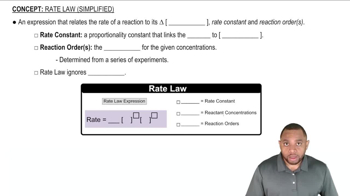
What does the rate law relate in a chemical reaction?
카드를 뒤집기 위해 탭할 수 있습니다.
👆
What does the rate law relate in a chemical reaction?
The rate law relates the reaction rate to the change in concentration of reactants, the rate constant, and the reaction order.
진행 상황 추적
컨트롤 버튼이 '내비게이션' 모드로 변경되었습니다.
1/15
관련 플래시카드
관련 실천
추천 영상
Rate Law (Simplified) definitions
Rate Law (Simplified)
13 용어
Chemical Equilibrium
7. Energy, Rate and Equilibrium
2 문제점
주제

Jules
7. Energy, Rate and Equilibrium - Part 1 of 3
5 주제
11 문제점
장
Jules
7. Energy, Rate and Equilibrium - Part 2 of 3
5 주제
11 문제점
장
Jules
7. Energy, Rate and Equilibrium - Part 3 of 3
3 주제
8 문제점
장
Jules
VideoThumbView.guidedCourse
2:15
Rate Law (Simplified) Concept 1
61
views
1
rank
VideoThumbView.guidedCourse
1:03
Rate Law (Simplified) Example 1
71
views
2
rank
이 집합의 용어 (15)
하이드의 정의
What does the rate law relate in a chemical reaction?
The rate law relates the reaction rate to the change in concentration of reactants, the rate constant, and the reaction order.
What does the triangle symbol (Δ) represent in the context of rate law?
The triangle symbol represents the change in concentration, calculated as final minus initial.
What do the brackets [ ] indicate in a rate law expression?
Brackets indicate the concentration of reactants, usually measured in molarity.
What is the role of the rate constant (k) in the rate law?
The rate constant (k) is a proportionality constant that links the reaction rate to the concentration of reactants.
How are reaction orders (exponents) determined in rate law?
Reaction orders are determined experimentally by analyzing how changes in reactant concentrations affect the reaction rate.
Does the rate law include products in its expression?
No, the rate law only includes reactants and ignores products.
What is the general form of the rate law for a reaction with two reactants, A and B?
The general form is rate = k[A]^x[B]^y, where x and y are the reaction orders for A and B.
What do the variables x and y represent in the rate law expression?
x and y represent the reaction orders for reactants A and B, respectively.
Can the rate law expression include more than two reactants?
Yes, the rate law can include additional reactants, such as C or Z, each with their own reaction order.
How is the concentration of reactants typically measured in rate law?
Concentration is typically measured in units of molarity (moles per liter).
Why is understanding rate law important in chemistry?
Understanding rate law is essential for analyzing reaction kinetics and enzyme activation energy.
What does the exponent in the rate law indicate about a reactant?
The exponent indicates how changes in the reactant's concentration affect the reaction rate.
If a reaction has only one reactant, how is the rate law written?
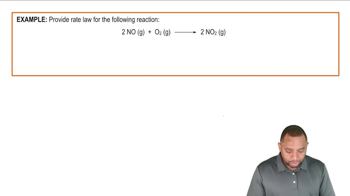
The rate law is written as rate = k[A]^x, where A is the reactant and x is its reaction order.
What is the significance of the rate constant (k) in the rate law?
The rate constant determines the proportionality between the rate and the concentrations raised to their respective orders.
How do textbooks sometimes denote reaction orders besides x and y?
Textbooks may use prime or double prime notation, but x, y, and z are commonly used for simplicity.