Skip to main content
GOB Chemistry
나의 코스
배우기
시험 준비
AI 튜터
학습 가이드
교과서적 해결책
플래시카드
탐험해 보세요
앱을 사용해 보세요
나의 코스
배우기
시험 준비
AI 튜터
학습 가이드
교과서적 해결책
플래시카드
탐험해 보세요
앱을 사용해 보세요
뒤로
Solutions quiz
카드를 뒤집기 위해 탭할 수 있습니다.
What is a solution in chemistry?
카드를 뒤집기 위해 탭할 수 있습니다.
👆
What is a solution in chemistry?
A solution is a homogeneous mixture made up of two or more components that form a uniform composition.
진행 상황 추적
컨트롤 버튼이 '내비게이션' 모드로 변경되었습니다.
1/15
관련 플래시카드
관련 실천
추천 영상
Solutions definitions
Solutions
13 용어
Solutions
9. Solutions
3 문제점
주제
Jules
Solubility and Intermolecular Forces
9. Solutions
4 문제점
주제
Jules
9. Solutions - Part 1 of 4
5 주제
12 문제점
장
Jules
9. Solutions - Part 2 of 4
7 주제
11 문제점
장
Jules
9. Solutions - Part 3 of 4
8 주제
13 문제점
장
Jules
9. Solutions - Part 4 of 4
2 주제
2 문제점
장
VideoThumbView.guidedCourse
01:16
Solutions Example 2
9806
views
220
rank
1
comments
VideoThumbView.guidedCourse
02:38
Solutions
11563
views
109
rank
VideoThumbView.guidedCourse
00:42
Solutions Example 1
11935
views
164
rank
이 집합의 용어 (15)
하이드의 정의
What is a solution in chemistry?
A solution is a homogeneous mixture made up of two or more components that form a uniform composition.
What does it mean for a mixture to have a uniform composition?
It means that everything is mixed perfectly together and you cannot distinguish one part from another.
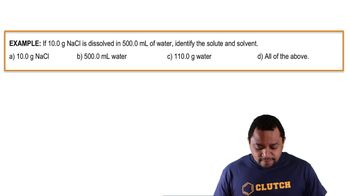
What is the solute in a solution?
The solute is the smaller portion of the solution that is dissolved within the solvent.
What is the solvent in a solution?
The solvent is the part of the solution present in the larger amount and is capable of dissolving other substances.
How is concentration defined in the context of solutions?
Concentration is a measurement of the amount of solute present in a given volume of solution.
What happens when a solute dissolves in a solvent?
When a solute dissolves in a solvent, they form a homogeneous solution with a uniform composition.
What are the three main types of mixtures discussed?
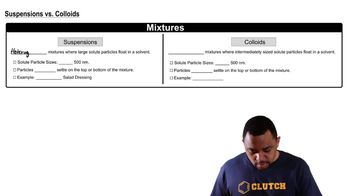
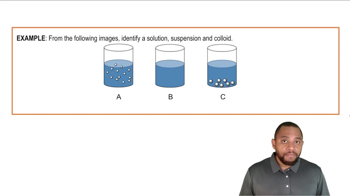
The three main types of mixtures are solutions, suspensions, and colloids.
How do suspensions differ from solutions?
Suspensions are heterogeneous mixtures with large particles that can float and eventually settle, unlike solutions which are homogeneous.
What is the typical particle size in a suspension?
Particles in a suspension are typically greater than 500 nanometers in size.
Why do particles in a suspension eventually settle?
Because the particles are large, gravity causes them to settle either at the top or bottom depending on density.
What is a colloid?
A colloid is a homogeneous mixture with intermediate-sized particles that remain suspended and do not settle.
How do the particle sizes in colloids compare to those in suspensions?
Colloid particles are less than 500 nanometers, which is smaller than those in suspensions.
Give an example of a suspension and explain why.
Italian salad dressing is a suspension because you can see oil, vinegar, herbs, and spices floating and eventually settling.
Give an example of a colloid and explain why.
Milk is a colloid because it contains fat and protein particles that stay suspended and do not settle.
Why do colloid particles not settle like those in suspensions?
Colloid particles are small enough to remain suspended and do not settle at the top or bottom of the solvent.
 뒤로뒤로
뒤로뒤로
 01:16
01:16