Skip to main content
GOB Chemistry
나의 코스
배우기
시험 준비
AI 튜터
학습 가이드
교과서적 해결책
플래시카드
탐험해 보세요
앱을 사용해 보세요
나의 코스
배우기
시험 준비
AI 튜터
학습 가이드
교과서적 해결책
플래시카드
탐험해 보세요
앱을 사용해 보세요
뒤로
Stoichiometry quiz
카드를 뒤집기 위해 탭할 수 있습니다.
What is the first step before performing any stoichiometric calculation?
카드를 뒤집기 위해 탭할 수 있습니다.
👆
What is the first step before performing any stoichiometric calculation?
The first step is to balance the chemical equation.
진행 상황 추적
컨트롤 버튼이 '내비게이션' 모드로 변경되었습니다.
1/15
관련 플래시카드
관련 실천
추천 영상
Stoichiometry definitions
Stoichiometry
15 용어
Stoichiometry
6. Chemical Reactions & Quantities
6 문제점
주제
Jules
Limiting Reagent
6. Chemical Reactions & Quantities
5 문제점
주제
Jules
6. Chemical Reactions & Quantities - Part 1 of 2
6 주제
9 문제점
장
Jules
6. Chemical Reactions & Quantities - Part 2 of 2
3 주제
8 문제점
장
Jules
VideoThumbView.guidedCourse
01:16
Stoichiometry
16241
views
202
rank
VideoThumbView.guidedCourse
03:04
Stoichiometry
13217
views
159
rank
VideoThumbView.guidedCourse
05:53
Stoichiometry Example 1
6374
views
69
rank
이 집합의 용어 (15)
하이드의 정의
What is the first step before performing any stoichiometric calculation?
The first step is to balance the chemical equation.
What does stoichiometry allow us to determine in a chemical reaction?
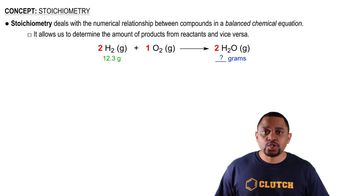
Stoichiometry allows us to determine the amount of products from reactants and vice versa.
Why is a balanced chemical equation essential for stoichiometry?
A balanced equation is essential because it provides the correct mole-to-mole ratios needed for calculations.
What is the purpose of the stoichiometric chart?
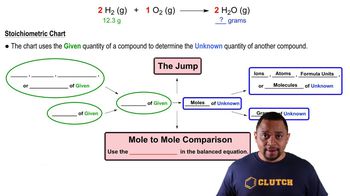
The stoichiometric chart helps convert given information about a compound into moles and then to the unknown quantity of another compound.
What is the 'given information' in a stoichiometric problem?
The given information is the quantity of a compound provided in the problem, such as grams, ions, atoms, or molecules.
What is the first conversion step if the given information is in grams?
The first step is to convert grams of the given compound to moles of the given compound.
What is the 'jump' or 'leap of faith' in stoichiometry?
The 'jump' refers to converting from moles of the given compound to moles of the unknown compound using the balanced equation.
How do you perform a mole-to-mole comparison in stoichiometry?
You use the coefficients from the balanced chemical equation to compare moles of the given and unknown compounds.
After finding moles of the unknown, what can you convert to next?
You can convert moles of the unknown to grams, ions, atoms, formula units, or molecules of the unknown.
In the example provided, what is the given compound and its quantity?
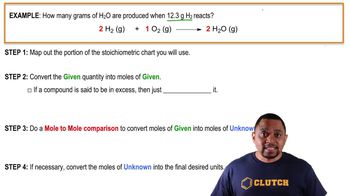
The given compound is H2, and its quantity is 12.3 grams.
What is the unknown compound in the example, and what are you asked to find?
The unknown compound is H2O, and you are asked to find the grams of H2O produced.
Why must you always start with a balanced equation in stoichiometry?
Because the coefficients in the balanced equation are needed for accurate mole-to-mole conversions.
What are the possible units for the given information in a stoichiometric problem?
The given information can be in grams, ions, atoms, formula units, or molecules.
What is the general path for solving a stoichiometric problem starting with grams of a reactant?
The path is: grams of given → moles of given → moles of unknown → grams of unknown.
How does the stoichiometric chart help in solving stoichiometry questions?
It visually guides you through the necessary conversions from the given information to the unknown quantity.
 뒤로뒤로
뒤로뒤로
 01:16
01:16