Skip to main content
GOB Chemistry
나의 코스
배우기
시험 준비
AI 튜터
학습 가이드
교과서적 해결책
플래시카드
탐험해 보세요
앱을 사용해 보세요
나의 코스
배우기
시험 준비
AI 튜터
학습 가이드
교과서적 해결책
플래시카드
탐험해 보세요
앱을 사용해 보세요
뒤로
Summary of Lipid Metabolism definitions
카드를 뒤집기 위해 탭할 수 있습니다.
Acetyl-CoA
카드를 뒤집기 위해 탭할 수 있습니다.
👆
Acetyl-CoA
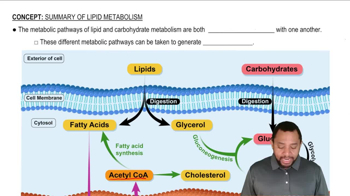
Central molecule linking lipid and carbohydrate metabolism, serving as both a key product and precursor in multiple metabolic pathways.
진행 상황 추적
컨트롤 버튼이 '내비게이션' 모드로 변경되었습니다.
1/15
관련 플래시카드
관련 실천
추천 영상
Summary of Lipid Metabolism quiz
Summary of Lipid Metabolism
15 용어
Summary of Lipid Metabolism
24. Lipid Metabolism
4 문제점
주제
Laura
Ketone Bodies
24. Lipid Metabolism
3 문제점
주제
Laura
24. Lipid Metabolism - Part 1 of 2
8 주제
15 문제점
장
KeyshawnDavis
24. Lipid Metabolism - Part 2 of 2
1 주제
3 문제점
장
Nicole
VideoThumbView.guidedCourse
1:44
Summary of Lipid Metabolism Example 1
1475
views
VideoThumbView.guidedCourse
5:50
Summary of Lipid Metabolism Concept 1
1479
views
이 집합의 용어 (15)
하이드의 정의
Acetyl-CoA
Central molecule linking lipid and carbohydrate metabolism, serving as both a key product and precursor in multiple metabolic pathways.
Citric Acid Cycle
Series of reactions in the mitochondrial matrix where Acetyl-CoA is oxidized, producing energy carriers for ATP synthesis.
Oxidative Phosphorylation
Process in mitochondria where energy from electron carriers is used to generate ATP, following the citric acid cycle.
Ketone Bodies
Energy-rich molecules formed from Acetyl-CoA during low carbohydrate availability, exported from mitochondria for use by other tissues.
Fatty Acid Synthesis
Anabolic process in the cytosol where Acetyl-CoA is converted into long-chain fatty acids for energy storage.
Cholesterol Formation
Biosynthetic pathway using Acetyl-CoA to produce a vital lipid component of cell membranes and precursor for steroid hormones.
Catabolic Pathways
Metabolic routes that break down lipids and carbohydrates to generate Acetyl-CoA and release energy.
Anabolic Pathways
Metabolic routes that use Acetyl-CoA to build complex molecules like fatty acids, ketone bodies, and cholesterol.
Beta Oxidation
Mitochondrial process where fatty acids are sequentially broken down to produce Acetyl-CoA.
Gluconeogenesis
Pathway that synthesizes glucose from non-carbohydrate sources such as glycerol and pyruvate, especially during fasting.
Glycolysis
Cytosolic pathway converting glucose into pyruvate, providing substrates for further energy production.
Mitochondrial Matrix
Innermost compartment of mitochondria where key metabolic processes like the citric acid cycle and beta oxidation occur.
Cell Membrane
Barrier regulating the entry and exit of lipids and carbohydrates, initiating their metabolic processing.
Glycerol
Three-carbon molecule derived from lipid digestion, entering gluconeogenesis or glycolysis to link lipid and carbohydrate metabolism.
Pyruvate
Three-carbon intermediate from glycolysis, transported into mitochondria for conversion into Acetyl-CoA or glucose synthesis.
 뒤로뒤로
뒤로뒤로
 1:44
1:44