Skip to main content
GOB Chemistry
나의 코스
배우기
시험 준비
AI 튜터
학습 가이드
교과서적 해결책
플래시카드
탐험해 보세요
앱을 사용해 보세요
나의 코스
배우기
시험 준비
AI 튜터
학습 가이드
교과서적 해결책
플래시카드
탐험해 보세요
앱을 사용해 보세요
뒤로
GOB Chemistry: Ions and Ionic Compounds
카드를 뒤집기 위해 탭할 수 있습니다.
What is an ion?
카드를 뒤집기 위해 탭할 수 있습니다.
👆
What is an ion?
An ion is an atom carrying a charge, either positive (cation) or negative (anion), formed by gaining or losing electrons.
진행 상황 추적
컨트롤 버튼이 '내비게이션' 모드로 변경되었습니다.
1/24
추천 영상
VideoThumbView.guidedCourse
00:53
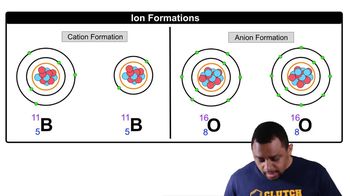
Ions (Simplified) Concept 1
5714
views
96
rank
VideoThumbView.guidedCourse
01:59
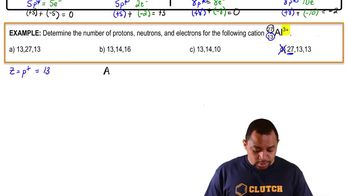
Ions (Simplified) Concept 2
5150
views
51
rank
VideoThumbView.guidedCourse
02:22
Ions (Simplified) Example 1
9025
views
116
rank
이 집합의 용어 (24)
하이드의 정의
What is an ion?
An ion is an atom carrying a charge, either positive (cation) or negative (anion), formed by gaining or losing electrons.
What is a cation?
A cation is a positively charged ion formed when an atom loses electrons.
What is an anion?
An anion is a negatively charged ion formed when an atom gains electrons.
What is the Octet Rule?
Atoms tend to gain or lose electrons to have 8 valence electrons, achieving the stable electron configuration of a noble gas.
Which elements are exceptions to the Octet Rule and why?
H, He, Li, and Be are exceptions because their full shell consists of only 2 electrons (1s2 configuration).
What charge do group 7 elements typically form and why?
Group 7 elements have 7 valence electrons and typically gain 1 electron to form ions with a charge of -1.
What charge do group 6 elements typically form?
Group 6 elements have 6 valence electrons and typically gain 2 electrons to form ions with a charge of -2.
What charge do group 5 elements typically form?
Group 5 elements have 5 valence electrons and typically gain 3 electrons to form ions with a charge of -3.
What charge do group 1 elements typically form and why?
Group 1 elements have 1 valence electron and typically lose 1 electron to form ions with a charge of +1.
What charge do group 2 elements typically form?
Group 2 elements have 2 valence electrons and typically lose 2 electrons to form ions with a charge of +2.
Why do group 4 elements usually not form ions?
Group 4 elements have 4 valence electrons and would need to gain or lose 4 electrons, which is energetically unfavorable.
How do transition metal ions differ from main group ions?
Transition metals can form multiple ion charges and do not follow a simple pattern like main group elements.
What charge does silver (Ag) typically form?
Silver typically forms a +1 ion.
What charge does zinc (Zn) typically form?
Zinc typically forms a +2 ion.
Give examples of multiple charges formed by iron (Fe).
Iron can form Fe+1, Fe+2, and Fe+3 ions depending on conditions.
What are polyatomic ions?
Polyatomic ions are clusters of atoms bonded together that carry an overall charge.
How should polyatomic ions be treated when forming ionic compounds?
Polyatomic ions are treated like single ions with a charge when forming ionic compounds.
Name the hydronium ion and its charge.
Hydronium ion is H3O+ with a charge of +1.
Name the ammonium ion and its charge.
Ammonium ion is NH4+ with a charge of +1.
What is the formula and charge of the sulfate ion?
Sulfate ion is SO42- with a charge of -2.
What is the formula and charge of the nitrate ion?
Nitrate ion is NO3- with a charge of -1.
What is the formula and charge of the phosphate ion?
Phosphate ion is PO43- with a charge of -3.
What is the formula and charge of the hydroxide ion?
Hydroxide ion is OH- with a charge of -1.
What is the formula and charge of the carbonate ion?
Carbonate ion is CO32- with a charge of -2.
 뒤로뒤로
뒤로뒤로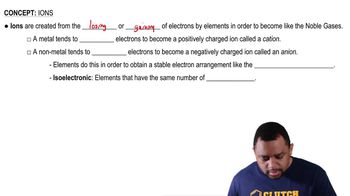
 00:53
00:53