Skip to main content
GOB Chemistry
나의 코스
배우기
시험 준비
AI 튜터
학습 가이드
교과서적 해결책
플래시카드
탐험해 보세요
앱을 사용해 보세요
나의 코스
배우기
시험 준비
AI 튜터
학습 가이드
교과서적 해결책
플래시카드
탐험해 보세요
앱을 사용해 보세요
뒤로
Naming Ionic Compounds - GOB Chemistry
카드를 뒤집기 위해 탭할 수 있습니다.
Order of ions in ionic formulas and names
카드를 뒤집기 위해 탭할 수 있습니다.
👆
Order of ions in ionic formulas and names
The cation (positive ion) is always listed first, followed by the anion (negative ion) in both formulas and names.
진행 상황 추적
컨트롤 버튼이 '내비게이션' 모드로 변경되었습니다.
1/20
추천 영상
VideoThumbView.guidedCourse
01:52
Naming Ionic Compounds
10842
views
78
rank
VideoThumbView.guidedCourse
01:01
Naming Ionic Compounds Example 1
10380
views
78
rank
VideoThumbView.guidedCourse
02:11
Naming Ionic Compounds
14469
views
126
rank
이 집합의 용어 (20)
하이드의 정의
Order of ions in ionic formulas and names
The cation (positive ion) is always listed first, followed by the anion (negative ion) in both formulas and names.
Naming main group cations
Name the cation by the element name only, e.g., Na+ is 'sodium'. The charge is implicit and not stated.
Naming polyatomic cations
Use the name of the polyatomic ion as given, e.g., NH4+ is 'ammonium'. The charge and formula are implicit.
IUPAC naming for transition metal cations
Name the element plus the charge in Roman numerals in parentheses, e.g., Fe3+ is 'iron (III)'.
Classical naming for transition metal cations
Use Latin-based names for different charges, e.g., Fe3+ is 'ferric', Fe2+ is 'ferrous'. This system is mostly used in medicine.
Exceptions where charge is not specified for transition metals
Silver (Ag+) and zinc (Zn2+) only have one stable charge, so no charge is specified in their names.
Naming main group anions
Name the element with an -ide suffix, e.g., O2- is 'oxide', Cl- is 'chloride'. The charge is implicit.
Naming polyatomic anions
Use the name of the polyatomic ion as given, e.g., OH- is 'hydroxide'. The charge and formula are implicit.
General rule for naming ionic compounds
Name the cation first, then the anion, separated by a space, e.g., K3N is 'potassium nitride'.
Naming K3N
K+ is potassium, N3- is nitride, so the compound is named 'potassium nitride'.
Naming Cu(OH)2
Cu2+ is copper (II) or cupric, OH- is hydroxide, so the compound is 'copper (II) hydroxide' or 'cupric hydroxide'.
Steps to determine ionic formula from compound name
Identify symbols, determine cation and anion charges, then find the lowest ratio to balance charges to zero.
Formula for magnesium sulfate
Mg2+ and SO42- charges balance 1:1, so formula is MgSO4.
Formula for copper (I) sulfite
Cu+ and SO32- require 2 Cu+ ions per sulfite ion, formula is Cu2SO3.
Why specify charge for transition metals in names?
Transition metals can have multiple charges, so the charge must be indicated to avoid ambiguity.
What suffix is used for main group anions?
The suffix '-ide' is added to the element name to form the anion name.
What is implicit in the name of an ion?
The fact that it is an ion and its charge are understood and do not need to be explicitly stated.
Difference between IUPAC and classical naming for transition metals
IUPAC uses Roman numerals for charge; classical uses Latin-based names for different charges.
Why learn classical names if outdated?
Classical names are still used in the medical community and on product labels.
How to name polyatomic ions in compounds
Use the polyatomic ion's given name directly without adding 'ion' or charge.
 뒤로뒤로
뒤로뒤로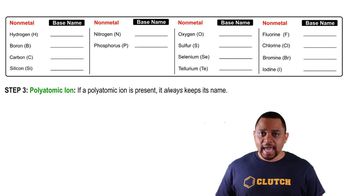
 01:52
01:52