Ch.4 Introduction to Organic Compounds
Frost - General, Organic and Biological Chemistry 4th Edition
Frost4th EditionGeneral, Organic and Biological ChemistryISBN: 9780134988696당신이 사용하는 게 아니라요?교과서 변경
1장, 문제 82c

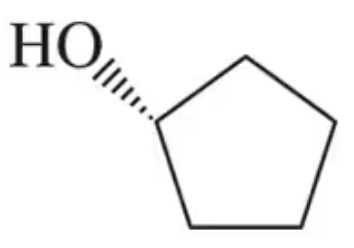
Draw the enantiomer of each of the following compounds. If the compound is not chiral, state that fact.
(c) Chemical structure of a pentagon with an -OH group attached, indicating a non-chiral compound.

검증된 단계별 안내
1
Analyze the given structure: The compound is a cyclopentane ring with a hydroxyl (-OH) group attached via a wedge bond, indicating stereochemistry.
Determine chirality: A compound is chiral if it has a carbon atom bonded to four different groups and lacks a plane of symmetry. In this case, the carbon attached to the -OH group is bonded to two identical groups (two hydrogens), making the compound achiral.
State the conclusion: Since the compound is not chiral, it does not have an enantiomer.
Explain why enantiomers cannot exist: Enantiomers are non-superimposable mirror images of chiral molecules. Because this molecule is achiral, it cannot have a non-superimposable mirror image.
Summarize: The compound is achiral, and no enantiomer can be drawn for this structure.

비슷한 문제에 대한 검증된 영상 답변:

이 영상 해법은 위 문제에 도움이 된다고 튜터들이 추천한 것입니다.
영상 길이:
2m

주요 개념

질문에 올바르게 답하기 위해 반드시 이해해야 하는 핵심 개념들은 다음과 같습니다.

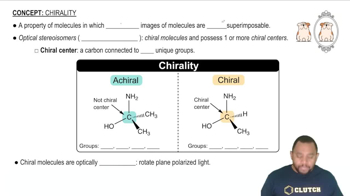
Chirality

Chirality refers to the geometric property of a molecule that makes it non-superimposable on its mirror image. A chiral molecule typically has four different substituents attached to a central carbon atom, creating two distinct forms known as enantiomers. Understanding chirality is crucial for determining whether a compound can exist in multiple forms that differ in spatial arrangement.
추천 영상:
가이드 코스
1:39
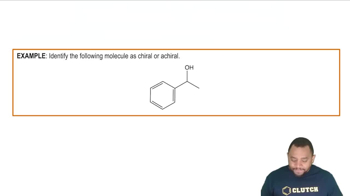
Chirality Example 1

Enantiomers

Enantiomers are a pair of molecules that are mirror images of each other but cannot be superimposed. They often exhibit different optical activities, meaning they rotate plane-polarized light in opposite directions. Identifying enantiomers is essential in organic chemistry, especially in the context of pharmaceuticals, where different enantiomers can have vastly different biological effects.
추천 영상:
가이드 코스
3:33
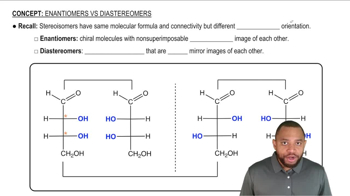
Enantiomers vs Diastereomers Concept 1

Chiral Centers

A chiral center, often a carbon atom, is a point in a molecule where four different groups are attached, leading to chirality. If a molecule lacks a chiral center, it is considered achiral and does not have enantiomers. In the provided compound, the absence of a chiral center indicates that it is not chiral, and thus, no enantiomer can be drawn.
추천 영상:
가이드 코스
2:37
Chirality Concept 1