What are the molarity and the normality of a solution made by dissolving 25 g of citric acid (triprotic, C6H5O7H3) in enough water to make 800 mL of solution?
Ch.10 Acids and Bases
McMurry8th EditionFundamentals of General, Organic, and Biological ChemistryISBN: 9780134015187당신이 사용하는 게 아니라요?교과서 변경
10장, 문제 88a
How many equivalents of an acid or base are in the following?
a. 0.25 mol Mg(OH)2
검증된 단계별 안내1
Identify the concept of equivalents: In acid-base chemistry, an equivalent is the amount of a substance that reacts with or supplies one mole of hydrogen ions (H⁺) or hydroxide ions (OH⁻). For bases, the number of equivalents is determined by the number of OH⁻ ions the base can release per mole.
Determine the chemical formula of the base: The given compound is magnesium hydroxide, Mg(OH)₂. Each formula unit of Mg(OH)₂ contains two hydroxide ions (OH⁻).
Calculate the number of equivalents per mole of Mg(OH)₂: Since each mole of Mg(OH)₂ releases 2 moles of OH⁻ ions, there are 2 equivalents of base per mole of Mg(OH)₂.
Multiply the number of moles of Mg(OH)₂ by the number of equivalents per mole: Use the relationship: \( \text{Equivalents} = \text{moles} \times \text{equivalents per mole} \). Substituting the given value, \( 0.25 \text{ mol Mg(OH)₂} \times 2 \text{ equivalents/mol} \).
Simplify the expression to find the total number of equivalents: Perform the multiplication to determine the total equivalents of the base present in 0.25 mol of Mg(OH)₂.

비슷한 문제에 대한 검증된 영상 답변:
이 영상 해법은 위 문제에 도움이 된다고 튜터들이 추천한 것입니다.
영상 길이:
1m주요 개념
질문에 올바르게 답하기 위해 반드시 이해해야 하는 핵심 개념들은 다음과 같습니다.
Equivalents in Acid-Base Chemistry
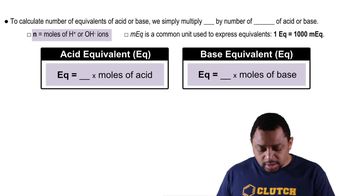
In acid-base chemistry, an equivalent refers to the amount of a substance that can donate or accept one mole of protons (H⁺ ions). For acids, this is often the number of protons they can donate, while for bases, it is the number of protons they can accept. Understanding equivalents is crucial for stoichiometric calculations in titrations and reactions involving acids and bases.
추천 영상:
가이드 코스
Acid-Base Equivalents Concept 2
Stoichiometry of Magnesium Hydroxide
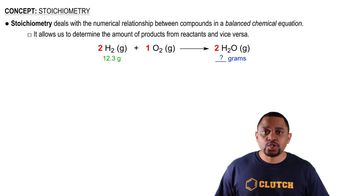
Magnesium hydroxide, Mg(OH)₂, is a strong base that dissociates in water to produce magnesium ions (Mg²⁺) and hydroxide ions (OH⁻). Each formula unit of Mg(OH)₂ can provide two hydroxide ions, which means it can neutralize two protons. This stoichiometric relationship is essential for calculating the number of equivalents present in a given amount of the compound.
추천 영상:
가이드 코스
Stoichiometry
Calculating Equivalents
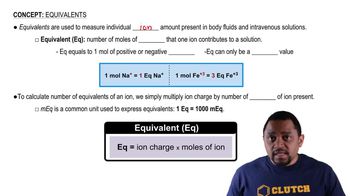
To calculate the number of equivalents of a substance, you multiply the number of moles by the number of reactive units per mole. For Mg(OH)₂, with 0.25 moles present and each mole providing two equivalents (due to two hydroxide ions), the calculation would be 0.25 moles × 2 equivalents/mole, resulting in 0.5 equivalents. This method is fundamental in determining the reactivity of acids and bases in various chemical reactions.
추천 영상:
가이드 코스
Equivalents Concept 1
관련 실천
교과서 질문
982
views
교과서 질문
The pH of a buffer solution containing 0.10 M acetic acid and 0.10 M sodium acetate is 4.74.
a. Write the Henderson–Hasselbalch equation for this buffer.
911
views
교과서 질문
What are the molarity and the normality of a solution made by dissolving 5.0 g of Ca(OH)2 in enough water to make 500.0 mL of solution?
1362
views
교과서 질문
How does normality compare to molarity for monoprotic and polyprotic acids?
2398
views
교과서 질문
A solution is prepared by bubbling 15.0 L of HCl(g) at 25 °C and 1 atm into 250.0 mL of water.
a. Assuming all the HCl dissolves in the water, how many moles of HCl are in solution?
2577
views
교과서 질문
Identify the number of equivalents per mole for each of the following acids and bases.
b. H3PO4
825
views