Ch.17 Carboxylic Acids and Their Derivatives
McMurry - Fundamentals of General, Organic, and Biological Chemistry 8th Edition
McMurry8th EditionFundamentals of General, Organic, and Biological ChemistryISBN: 9780134015187당신이 사용하는 게 아니라요?교과서 변경
17장, 문제 14b

Write the products of the following reactions:
b. 2, 2-Dimethylpentanoic acid + KOH → ?

검증된 단계별 안내
1
Identify the type of reaction: This is an acid-base reaction where 2,2-dimethylpentanoic acid (a carboxylic acid) reacts with potassium hydroxide (KOH, a strong base). The carboxylic acid will donate a proton (H⁺) to the hydroxide ion (OH⁻), forming water and the conjugate base of the acid.
Write the chemical formula for 2,2-dimethylpentanoic acid: The structure of 2,2-dimethylpentanoic acid is CH₃C(CH₃)₂CH₂CH₂COOH. The carboxylic acid group (-COOH) is the reactive site in this reaction.
Determine the conjugate base formed: When the carboxylic acid loses a proton (H⁺), it forms a carboxylate ion (-COO⁻). The conjugate base of 2,2-dimethylpentanoic acid is CH₃C(CH₃)₂CH₂CH₂COO⁻.
Combine the conjugate base with the potassium ion: The potassium ion (K⁺) from KOH will pair with the carboxylate ion to form the salt, potassium 2,2-dimethylpentanoate (CH₃C(CH₃)₂CH₂CH₂COOK).
Write the balanced reaction: The overall reaction is CH₃C(CH₃)₂CH₂CH₂COOH + KOH → CH₃C(CH₃)₂CH₂CH₂COOK + H₂O. This shows the formation of the salt and water as products.

비슷한 문제에 대한 검증된 영상 답변:

이 영상 해법은 위 문제에 도움이 된다고 튜터들이 추천한 것입니다.
영상 길이:
2m

주요 개념

질문에 올바르게 답하기 위해 반드시 이해해야 하는 핵심 개념들은 다음과 같습니다.

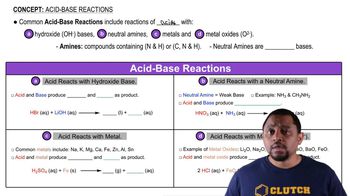
Acid-Base Reaction

An acid-base reaction involves the transfer of protons (H+) between reactants. In this case, 2,2-Dimethylpentanoic acid, a carboxylic acid, donates a proton to KOH, a strong base. This results in the formation of a salt and water, which is a typical outcome of neutralization reactions.
추천 영상:
가이드 코스
03:08
Acid-Base Reactions Concept 1

Carboxylic Acids

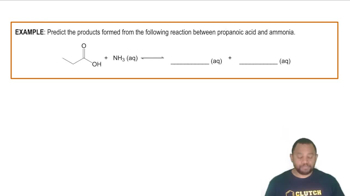
Carboxylic acids are organic compounds characterized by the presence of a carboxyl group (-COOH). They are known for their acidic properties due to the ability to donate protons. In the reaction with KOH, the carboxylic acid will react to form a carboxylate salt, which is a key product in acid-base reactions.
추천 영상:
가이드 코스
1:09
Carboxylic Acid Reactions Example 1

Potassium Hydroxide (KOH)

Potassium hydroxide is a strong base that dissociates completely in water to produce hydroxide ions (OH-). In the context of the reaction, KOH reacts with the carboxylic acid to neutralize it, leading to the formation of potassium salt of the acid and water. Understanding the role of KOH is essential for predicting the products of the reaction.
추천 영상:
가이드 코스
1:58
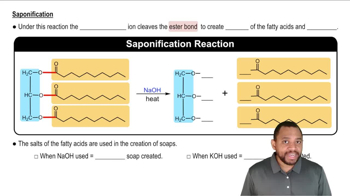
Triacylglycerol Reactions: Hydrolysis Concept 2