Ch.18 Amino Acids and Proteins
McMurry - Fundamentals of General, Organic, and Biological Chemistry 8th Edition
McMurry8th EditionFundamentals of General, Organic, and Biological ChemistryISBN: 9780134015187당신이 사용하는 게 아니라요?교과서 변경
18장, 문제 67

What is the sequence of atoms along the "backbone" of a protein?

검증된 단계별 안내
1
Understand that the 'backbone' of a protein refers to the repeating sequence of atoms that form the main structural framework of the protein, excluding the side chains (R groups).
Recall that proteins are polymers made up of amino acids linked together by peptide bonds. Each amino acid consists of an amine group (-NH₂), a carboxyl group (-COOH), a hydrogen atom, and a variable side chain (R group) attached to a central carbon atom (the alpha carbon).
When amino acids link together to form a protein, the carboxyl group of one amino acid reacts with the amine group of another, forming a peptide bond and releasing a molecule of water (a condensation reaction).
The resulting backbone of the protein consists of a repeating sequence of atoms: -N-C-C-. Specifically, this sequence includes the nitrogen atom from the amine group, the alpha carbon atom, and the carbon atom from the carboxyl group of each amino acid.
This -N-C-C- sequence repeats throughout the length of the protein, forming the structural backbone, while the side chains (R groups) extend outward from the alpha carbon atoms, giving the protein its unique properties and functions.

비슷한 문제에 대한 검증된 영상 답변:

이 영상 해법은 위 문제에 도움이 된다고 튜터들이 추천한 것입니다.
도움이 되었나요?

주요 개념

질문에 올바르게 답하기 위해 반드시 이해해야 하는 핵심 개념들은 다음과 같습니다.

Protein Structure

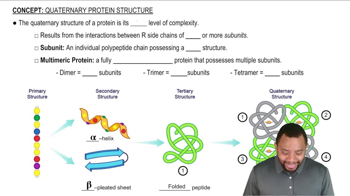
Proteins are complex molecules made up of amino acids, which are linked together in a specific sequence. The structure of a protein is crucial for its function, and it typically consists of four levels: primary, secondary, tertiary, and quaternary. The primary structure refers to the linear sequence of amino acids that form the protein's backbone.
추천 영상:
가이드 코스
3:26
Quaternary Protein Structure Concept 1

Amino Acids

Amino acids are the building blocks of proteins, each containing an amino group, a carboxyl group, and a unique side chain. There are 20 standard amino acids, and their specific sequence determines the protein's structure and function. The backbone of a protein is formed by the peptide bonds between the amino acids, linking them in a chain.
추천 영상:
가이드 코스
3:03
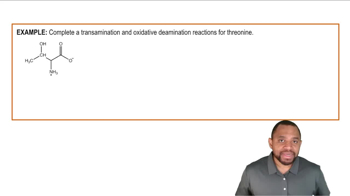
Amino Acid Catabolism: Amino Group Example 2

Peptide Bonds

Peptide bonds are covalent bonds that link amino acids together in a protein. They form through a dehydration reaction, where the carboxyl group of one amino acid reacts with the amino group of another, releasing a molecule of water. This bond creates the backbone of the protein, which is essential for maintaining its structural integrity and function.
추천 영상:
가이드 코스
1:24
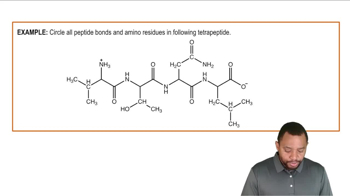
Peptides Example 1