Ch.21 The Generation of Biochemical Energy
McMurry - Fundamentals of General, Organic, and Biological Chemistry 8th Edition
McMurry8th EditionFundamentals of General, Organic, and Biological ChemistryISBN: 9780134015187당신이 사용하는 게 아니라요?교과서 변경
21장, 문제 15

Which of the reactants in the citric acid cycle have two chiral carbon atoms?

검증된 단계별 안내
1
Understand the citric acid cycle: The citric acid cycle (also known as the Krebs cycle or TCA cycle) is a series of chemical reactions used by aerobic organisms to generate energy through the oxidation of acetyl-CoA. It involves several intermediates, some of which are chiral molecules.
Review the concept of chirality: A chiral carbon atom is a carbon atom that is bonded to four different groups. Molecules with chiral carbons can exist as non-superimposable mirror images (enantiomers).
Identify the intermediates in the citric acid cycle: The main intermediates include citrate, isocitrate, α-ketoglutarate, succinyl-CoA, succinate, fumarate, malate, and oxaloacetate. Not all of these intermediates are chiral.
Determine which intermediates have two chiral carbons: Analyze the molecular structure of each intermediate. For example, isocitrate has two chiral carbons because it contains two carbon atoms each bonded to four different groups.
Conclude that isocitrate is the reactant in the citric acid cycle with two chiral carbon atoms. Other intermediates may have one or no chiral carbons, but isocitrate specifically has two.

비슷한 문제에 대한 검증된 영상 답변:

이 영상 해법은 위 문제에 도움이 된다고 튜터들이 추천한 것입니다.
영상 길이:
4m

주요 개념

질문에 올바르게 답하기 위해 반드시 이해해야 하는 핵심 개념들은 다음과 같습니다.

Chirality

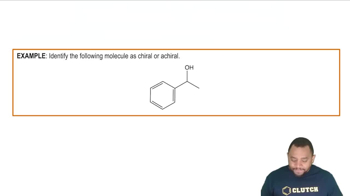
Chirality refers to the geometric property of a molecule having a non-superimposable mirror image, much like left and right hands. A chiral carbon atom is one that is attached to four different substituents, leading to two distinct configurations, known as enantiomers. Understanding chirality is essential in biochemistry, as it can influence the behavior and interaction of molecules in biological systems.
추천 영상:
가이드 코스
1:39
Chirality Example 1

Citric Acid Cycle

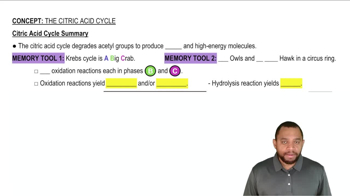
The citric acid cycle, also known as the Krebs cycle, is a key metabolic pathway that occurs in the mitochondria of cells. It plays a crucial role in cellular respiration by oxidizing acetyl-CoA to produce energy in the form of ATP, as well as electron carriers like NADH and FADH2. The cycle involves a series of enzymatic reactions, and understanding its components is vital for identifying reactants with specific structural features, such as chirality.
추천 영상:
가이드 코스
2:31
Citric Acid Cycle Summary Concept 12

Reactants in the Citric Acid Cycle

The reactants in the citric acid cycle include acetyl-CoA, oxaloacetate, and various intermediates such as citrate, isocitrate, and alpha-ketoglutarate. Each of these compounds plays a specific role in the cycle, and some contain chiral centers. Identifying which of these reactants have two chiral carbon atoms requires knowledge of their molecular structures and the ability to recognize chiral centers within them.
추천 영상:
가이드 코스
2:31
Citric Acid Cycle Summary Concept 12