Ch.25 Protein and Amino Acid Metabolism
McMurry - Fundamentals of General, Organic, and Biological Chemistry 8th Edition
McMurry8th EditionFundamentals of General, Organic, and Biological ChemistryISBN: 9780134015187당신이 사용하는 게 아니라요?교과서 변경
25장, 문제 23a

What is the structure of the ⍺-keto acid formed from transamination of the following amino acids?
a. Glutamic acid

검증된 단계별 안내
1
Understand the concept of transamination: Transamination is a biochemical reaction where an amino group (-NH₂) from an amino acid is transferred to an α-keto acid, typically α-ketoglutarate, forming a new amino acid and a new α-keto acid. In this case, we are identifying the α-keto acid formed when glutamic acid undergoes transamination.
Identify the structure of glutamic acid: Glutamic acid is an amino acid with the structure HOOC-CH₂-CH₂-CH(NH₂)-COOH. It contains an amino group (-NH₂) attached to the α-carbon and two carboxylic acid groups (-COOH).
Determine the α-keto acid formed: During transamination, the amino group (-NH₂) on the α-carbon of glutamic acid is removed and replaced with a keto group (=O). This results in the formation of an α-keto acid. The structure of the α-keto acid will be HOOC-CH₂-CH₂-CO-COOH.
Name the α-keto acid: The α-keto acid formed from glutamic acid is α-ketoglutaric acid (also known as 2-oxoglutaric acid). This compound is a key intermediate in the citric acid cycle.
Verify the reaction: Ensure that the reaction follows the general pattern of transamination, where the amino group is transferred to another molecule (e.g., α-ketoglutarate) and the original amino acid is converted into its corresponding α-keto acid.

비슷한 문제에 대한 검증된 영상 답변:

이 영상 해법은 위 문제에 도움이 된다고 튜터들이 추천한 것입니다.
영상 길이:
1m

주요 개념

질문에 올바르게 답하기 위해 반드시 이해해야 하는 핵심 개념들은 다음과 같습니다.

Transamination

Transamination is a biochemical process where an amino group from an amino acid is transferred to a keto acid, resulting in the formation of a new amino acid and a new keto acid. This reaction is crucial in amino acid metabolism and is catalyzed by enzymes known as transaminases or aminotransferases. For example, when glutamic acid undergoes transamination, it can donate its amino group to α-ketoglutarate, forming α-keto acid and another amino acid.
추천 영상:
가이드 코스
3:03
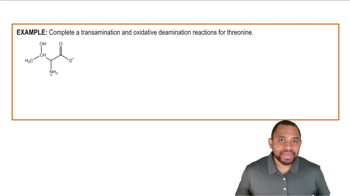
Amino Acid Catabolism: Amino Group Example 2

α-Keto Acid

An α-keto acid is a type of organic compound that contains a carbonyl group (C=O) adjacent to a carboxylic acid group (–COOH). These compounds play a significant role in metabolism, particularly in the Krebs cycle, where they serve as intermediates. The α-keto acid formed from the transamination of glutamic acid is α-ketoglutarate, which is essential for energy production and amino acid synthesis.
추천 영상:

Glutamic Acid

Glutamic acid is a non-essential amino acid that serves as a building block for proteins and plays a key role in cellular metabolism. It is involved in the synthesis of neurotransmitters and is a precursor for the formation of other amino acids. In the context of transamination, glutamic acid is often the donor of the amino group, facilitating the conversion of α-ketoglutarate into other amino acids, thus linking amino acid metabolism with energy production.
추천 영상:
가이드 코스
4:00
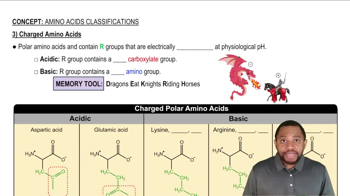
Charged Amino Acids Concept 3