Ch.11 Introduction to Organic Chemistry: Hydrocarbons
Timberlake - Chemistry: An Introduction to General, Organic, and Biological Chemistry 13th Edition
Timberlake13th EditionChemistry: An Introduction to General, Organic, and Biological ChemistryISBN: 9780134421353당신이 사용하는 게 아니라요?교과서 변경
11장, 문제 19d

Heptane, used as a solvent for rubber cement, has a density of 0.68 g/mL and boils at 98 °C.
d. Will heptane float on water or sink?

검증된 단계별 안내
1
Step 1: Recall the principle of buoyancy, which states that an object will float on a liquid if its density is less than the density of the liquid. Conversely, it will sink if its density is greater than the liquid's density.
Step 2: Identify the density of heptane from the problem, which is given as 0.68 g/mL.
Step 3: Compare the density of heptane to the density of water. The density of water is approximately 1.00 g/mL at standard conditions.
Step 4: Determine whether 0.68 g/mL (density of heptane) is less than or greater than 1.00 g/mL (density of water).
Step 5: Conclude whether heptane will float or sink based on the comparison of densities. If heptane's density is less than water's density, it will float; otherwise, it will sink.

비슷한 문제에 대한 검증된 영상 답변:

이 영상 해법은 위 문제에 도움이 된다고 튜터들이 추천한 것입니다.

주요 개념

질문에 올바르게 답하기 위해 반드시 이해해야 하는 핵심 개념들은 다음과 같습니다.

Density

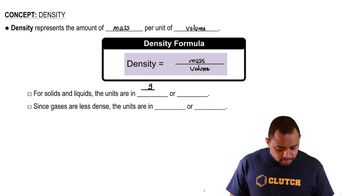
Density is defined as mass per unit volume, typically expressed in grams per milliliter (g/mL) for liquids. A substance will float on a liquid if its density is less than that of the liquid. In this case, heptane has a density of 0.68 g/mL, which is less than the density of water (approximately 1.00 g/mL), indicating that heptane is less dense than water.
추천 영상:

Buoyancy

Buoyancy is the upward force exerted by a fluid that opposes the weight of an object immersed in it. An object will float if the buoyant force is equal to or greater than its weight. Since heptane is less dense than water, it will experience a buoyant force sufficient to keep it afloat, confirming that it will float on water.

Phase Behavior of Liquids

Phase behavior refers to how different substances interact and behave in various states of matter. In the case of heptane and water, they are immiscible liquids, meaning they do not mix. This immiscibility, combined with the density difference, results in heptane forming a distinct layer on top of water, further supporting the conclusion that it will float.
추천 영상:
가이드 코스
03:25
Periodic Table: Phases (Simplified) Concept 1