
Ch.8 Gases
Timberlake - Chemistry: An Introduction to General, Organic, and Biological Chemistry 13th Edition
Timberlake13th EditionChemistry: An Introduction to General, Organic, and Biological ChemistryISBN: 9780134421353당신이 사용하는 게 아니라요?교과서 변경
8장, 문제 65b

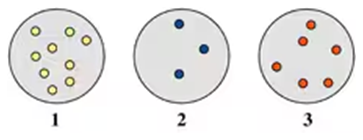
At 100 °C, which of the following diagrams (1, 2, or 3) represents a gas sample that exerts the:
b. highest pressure?

검증된 단계별 안내
1
Step 1: Recall the relationship between pressure and the number of gas particles in a given volume. According to the ideal gas law, pressure (P) is directly proportional to the number of gas particles (n) when the volume (V) and temperature (T) are constant.
Step 2: Examine the diagrams provided in the problem. Count the number of gas particles in each diagram to determine which one has the highest particle density.
Step 3: Consider the volume of the container in each diagram. If the containers are of equal volume, the diagram with the most gas particles will exert the highest pressure.
Step 4: Verify that the temperature is constant across all diagrams (100 °C in this case). Since temperature is constant, it does not affect the comparison of pressures between the diagrams.
Step 5: Identify the diagram with the highest number of gas particles in the same volume. This diagram represents the gas sample with the highest pressure.

비슷한 문제에 대한 검증된 영상 답변:

이 영상 해법은 위 문제에 도움이 된다고 튜터들이 추천한 것입니다.
영상 길이:
1m
도움이 되었나요?

주요 개념

질문에 올바르게 답하기 위해 반드시 이해해야 하는 핵심 개념들은 다음과 같습니다.

Gas Pressure

Gas pressure is the force exerted by gas molecules colliding with the walls of their container. It is influenced by factors such as temperature, volume, and the number of gas particles. According to the ideal gas law, pressure increases with temperature if the volume is constant, as higher temperatures lead to more energetic collisions.
추천 영상:
가이드 코스
01:15
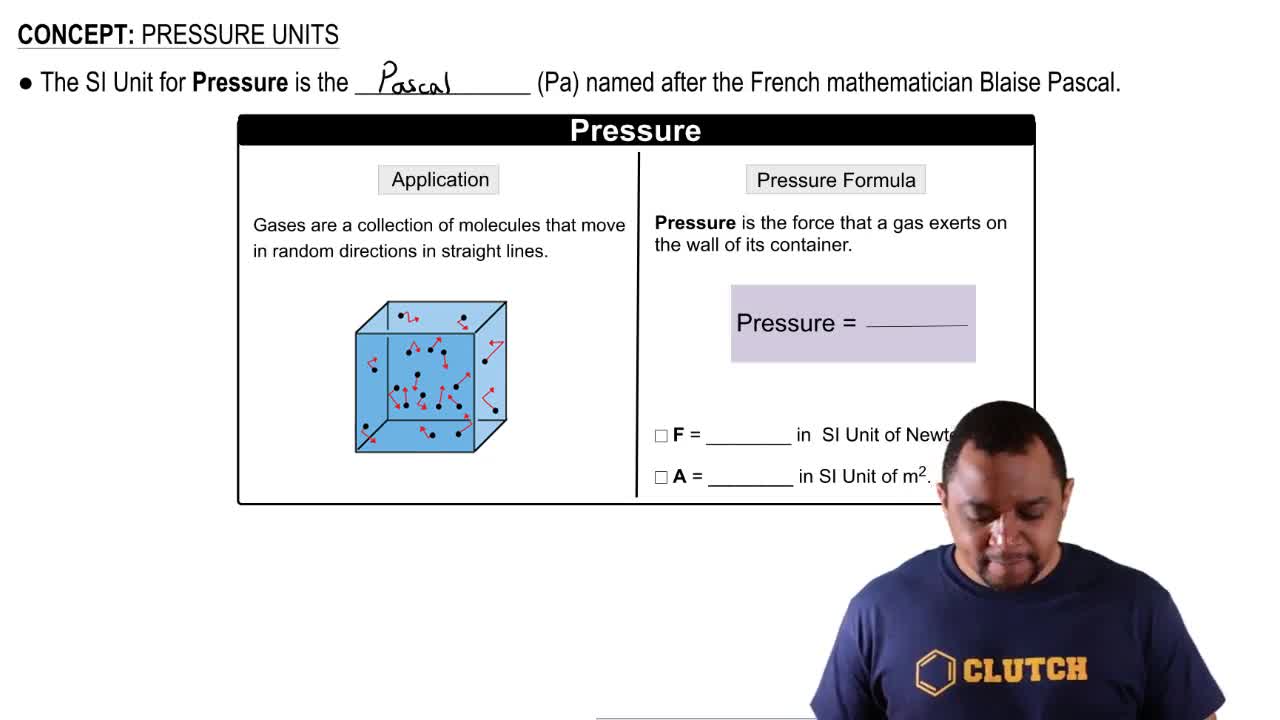
Pressure Units Concept 1

Ideal Gas Law

The ideal gas law is a fundamental equation in thermodynamics that relates pressure (P), volume (V), temperature (T), and the number of moles (n) of a gas. It is expressed as PV = nRT, where R is the ideal gas constant. This law helps predict how changes in one variable affect the others, particularly in understanding how pressure varies with temperature and volume.
추천 영상:
가이드 코스
01:15
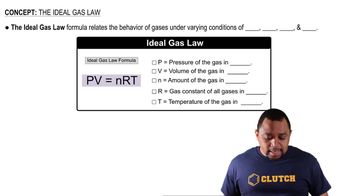
The Ideal Gas Law Concept 1

Kinetic Molecular Theory

Kinetic molecular theory explains the behavior of gases in terms of particle motion. It posits that gas particles are in constant, random motion and that their kinetic energy is directly proportional to the temperature of the gas. This theory helps explain why increasing temperature leads to increased pressure, as faster-moving particles collide more frequently and with greater force against the container walls.
추천 영상:
가이드 코스
01:19
Kinetic Molecular Theory Concept 1
관련 실천
교과서 질문

Two flasks of equal volume and at the same temperature contain different gases. One flask contains 5.0 g of O2 and the other flask contains 5.0 g of H2. Is each of the following statements true or false? Explain.

b. The pressures in the flasks are the same.

919
views
교과서 질문

Indicate which diagram (1, 2, or 3) represents the volume of the gas sample in a flexible container when each of the following changes (a to d) takes place:

d. Doubling the atmospheric pressure and doubling the Kelvin temperature.

2758
views
교과서 질문

In certain lung ailments such as emphysema, there is a decrease in the ability of oxygen to diffuse into the blood.

b. Why does a person with severe emphysema sometimes use a portable oxygen tank?

770
views
교과서 질문

Indicate which diagram (1, 2, or 3) represents the volume of the gas sample in a flexible container when each of the following changes (a to d) takes place:

c. Atmospheric pressure decreases if temperature does not change.

1595
views
교과서 질문

A balloon is filled with helium gas with a partial pressure of 1.00 atm and neon gas with a partial pressure of 0.50 atm. For each of the following changes (a to e) of the initial balloon, select the diagram (A, B, or C) that shows the final volume of the balloon:

<IMAGE>

c. All of the neon gas is removed (T and P do not change).

1245
views
교과서 질문

Using the answer from problem 8.61, how many grams of nitrogen are in Whitney's lungs at STP if air contains 78% nitrogen?

1954
views