Ch.10 Acids and Bases and Equilibrium
Timberlake - Chemistry: An Introduction to General, Organic, and Biological Chemistry 14th Edition
Timberlake14th EditionChemistry: An Introduction to General, Organic, and Biological ChemistryISBN: 9781292472249당신이 사용하는 게 아니라요?교과서 변경
10장, 문제 1a

Indicate whether each of the following statements is characteristic of an acid, a base, or both
c. produces H⁺ ions in water

검증된 단계별 안내
1
Understand the definition of an acid: Acids are substances that increase the concentration of hydrogen ions (H⁺) when dissolved in water. This is a key characteristic of acids according to the Arrhenius definition.
Recall the definition of a base: Bases are substances that increase the concentration of hydroxide ions (OH⁻) when dissolved in water. Bases do not produce H⁺ ions in water.
Compare the given statement to the definitions: The statement mentions the production of H⁺ ions in water, which aligns with the definition of an acid.
Conclude that the characteristic described in the statement is specific to acids and not bases, as bases do not produce H⁺ ions in water.
State the final classification: The statement 'produces H⁺ ions in water' is characteristic of an acid.

비슷한 문제에 대한 검증된 영상 답변:

이 영상 해법은 위 문제에 도움이 된다고 튜터들이 추천한 것입니다.
영상 길이:
1m

주요 개념

질문에 올바르게 답하기 위해 반드시 이해해야 하는 핵심 개념들은 다음과 같습니다.

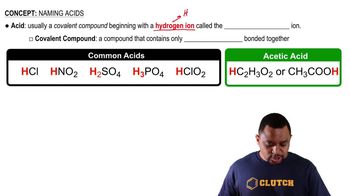
Acids

Acids are substances that, when dissolved in water, increase the concentration of hydrogen ions (H⁺). This characteristic is fundamental to their definition, as acids typically have a sour taste and can react with bases to form salts and water. Common examples include hydrochloric acid (HCl) and sulfuric acid (H₂SO₄).
추천 영상:

Bases

Bases are substances that, when dissolved in water, produce hydroxide ions (OH⁻) or can accept hydrogen ions (H⁺). They are often characterized by a bitter taste and slippery feel. Common examples include sodium hydroxide (NaOH) and ammonia (NH₃). Bases can neutralize acids, forming water and salts.
추천 영상:
가이드 코스
1:23
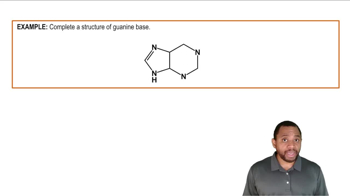
Nitrogenous Bases Example 3

pH Scale

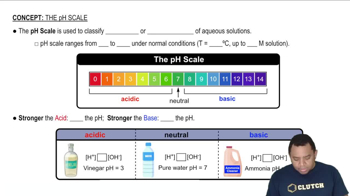
The pH scale measures the acidity or basicity of a solution, ranging from 0 to 14. A pH less than 7 indicates an acidic solution, while a pH greater than 7 indicates a basic solution. A pH of 7 is considered neutral, as seen in pure water. Understanding the pH scale is essential for determining the nature of a substance in aqueous solutions.
추천 영상: