Ch.10 Acids and Bases and Equilibrium
Timberlake - Chemistry: An Introduction to General, Organic, and Biological Chemistry 14th Edition
Timberlake14th EditionChemistry: An Introduction to General, Organic, and Biological ChemistryISBN: 9781292472249당신이 사용하는 게 아니라요?교과서 변경
10장, 문제 11a

Write the formula for the conjugate acid for each of the following bases:
a. CO32-

검증된 단계별 안내
1
Identify the base given in the problem. In this case, the base is the carbonate ion, CO₃²⁻.
Recall the definition of a conjugate acid: it is formed when a base accepts a proton (H⁺).
Add one proton (H⁺) to the base, CO₃²⁻. This involves increasing the hydrogen count by 1 and reducing the charge by 1, as the proton carries a positive charge.
Write the resulting formula after adding the proton. The formula becomes HCO₃⁻, which is the conjugate acid of CO₃²⁻.
Verify the result by checking that the conjugate acid has one more hydrogen atom and a charge that is one unit less positive than the original base.

비슷한 문제에 대한 검증된 영상 답변:

이 영상 해법은 위 문제에 도움이 된다고 튜터들이 추천한 것입니다.
영상 길이:
1m

주요 개념

질문에 올바르게 답하기 위해 반드시 이해해야 하는 핵심 개념들은 다음과 같습니다.

Conjugate Acid-Base Theory

Conjugate acid-base theory, rooted in the Brønsted-Lowry definition, describes acids as proton donors and bases as proton acceptors. When a base accepts a proton (H⁺), it forms its conjugate acid. Understanding this relationship is crucial for predicting the behavior of chemical species in acid-base reactions.
추천 영상:
가이드 코스
00:50
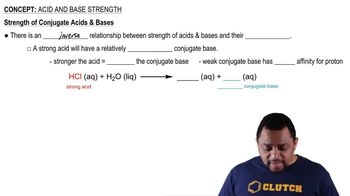
Acid and Base Strength Concept 3

Carbonate Ion (CO₃²⁻)

The carbonate ion (CO₃²⁻) is a polyatomic ion consisting of one carbon atom covalently bonded to three oxygen atoms, carrying a -2 charge. It acts as a base in chemical reactions, capable of accepting protons to form its conjugate acid. Recognizing its structure and charge is essential for determining its conjugate acid.
추천 영상:
가이드 코스
01:26
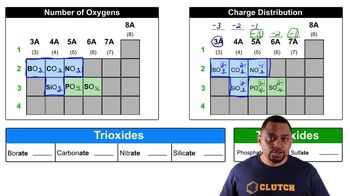
Polyatomic Ions

Formation of Conjugate Acids

The formation of a conjugate acid involves the addition of a proton to a base. For the carbonate ion (CO₃²⁻), when it accepts a proton, it transforms into bicarbonate (HCO₃⁻), which is its conjugate acid. This process illustrates the dynamic nature of acid-base chemistry and the importance of understanding proton transfer.
추천 영상:
가이드 코스
1:41
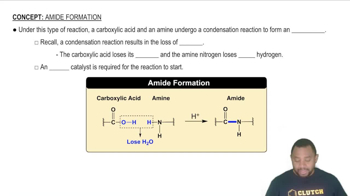
Amide Formation Concept 1