A compound with the formula C5H10O oxidizes to give 3-pentanone. Draw the condensed structural formula and give the IUPAC name for the compound.
Ch.12 Alcohols, Thiols, Ethers, Aldehydes, and Ketones
Timberlake14th EditionChemistry: An Introduction to General, Organic, and Biological ChemistryISBN: 9781292472249당신이 사용하는 게 아니라요?교과서 변경
12장, 문제 67
Compound A is a primary alcohol whose formula is C3H8O. When compound A is heated with strong acid, it dehydrates to form compound B (C3H6). When compound A is oxidized, compound C (C3H6O) forms. Draw the condensed structural formulas and give the IUPAC names for compounds A, B, and C.
검증된 단계별 안내1
Step 1: Identify the structure of compound A. Since compound A is a primary alcohol with the formula C₃H₈O, it must have a hydroxyl group (-OH) attached to a primary carbon. The possible structure is CH₃CH₂CH₂OH (1-propanol).
Step 2: Determine the product of dehydration (compound B). When a primary alcohol like 1-propanol is heated with a strong acid, it undergoes a dehydration reaction, losing a water molecule. This forms an alkene. The double bond can form between the first and second carbons, resulting in CH₂=CHCH₃ (propene).
Step 3: Determine the product of oxidation (compound C). When a primary alcohol like 1-propanol is oxidized, it forms an aldehyde. The hydroxyl group (-OH) is converted into a carbonyl group (C=O) at the end of the chain. This results in CH₃CH₂CHO (propanal).
Step 4: Write the IUPAC names for the compounds. Compound A is 1-propanol, compound B is propene, and compound C is propanal.
Step 5: Summarize the condensed structural formulas and IUPAC names: Compound A: CH₃CH₂CH₂OH (1-propanol), Compound B: CH₂=CHCH₃ (propene), Compound C: CH₃CH₂CHO (propanal).

비슷한 문제에 대한 검증된 영상 답변:
이 영상 해법은 위 문제에 도움이 된다고 튜터들이 추천한 것입니다.
도움이 되었나요?
주요 개념
질문에 올바르게 답하기 위해 반드시 이해해야 하는 핵심 개념들은 다음과 같습니다.
Alcohols and Their Properties
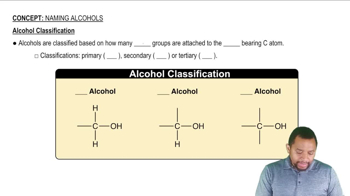
Alcohols are organic compounds characterized by the presence of one or more hydroxyl (-OH) groups. In this case, compound A is a primary alcohol, meaning the hydroxyl group is attached to a carbon atom that is connected to only one other carbon. Understanding the structure and reactivity of alcohols is essential for predicting their behavior during dehydration and oxidation reactions.
추천 영상:
가이드 코스
Alcohol Classification Concept 2
Dehydration Reaction
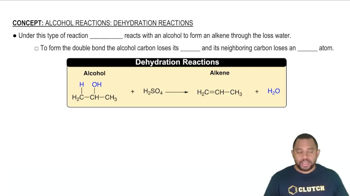
Dehydration is a chemical reaction that involves the removal of water (H₂O) from a compound. In the context of compound A, heating it with a strong acid facilitates the elimination of a water molecule, resulting in the formation of compound B, an alkene. This reaction is crucial for understanding how alcohols can convert to alkenes through the loss of water.
추천 영상:
가이드 코스
Alcohol Reactions: Dehydration Reactions Concept 1
Oxidation of Alcohols
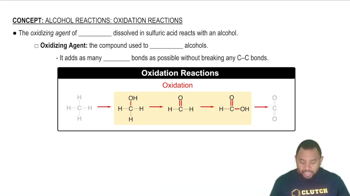
Oxidation refers to the process where a substance loses electrons, often involving the addition of oxygen or the removal of hydrogen. When compound A is oxidized, it transforms into compound C, which is an aldehyde in this case. Recognizing the oxidation states and the resulting functional groups is vital for determining the structure and IUPAC naming of the products formed from alcohols.
추천 영상:
가이드 코스
Alcohol Reactions: Oxidation Concept 1
관련 실천
교과서 질문
745
views
교과서 질문
Draw the condensed structural formulas and give the IUPAC names for all the aldehydes and ketones that have the formula C5H10O. (12.3)
920
views
교과서 질문
A compound with the formula C4H8O is synthesized from 2-methyl-1-propanol and oxidizes easily to give a carboxylic acid. Draw the condensed structural formula and give the IUPAC name for the compound.
890
views
교과서 질문
Compound X is a secondary alcohol whose formula is C3H8O. When compound X is heated with strong acid, it dehydrates to form compound Y (C3H6). When compound X is oxidized, compound Z (C3H6O) forms, which cannot be oxidized further. Draw the condensed structural formulas and give the IUPAC names for compounds X, Y, and Z.
928
views