Ch.13 Carbohydrates
Timberlake - Chemistry: An Introduction to General, Organic, and Biological Chemistry 14th Edition
Timberlake14th EditionChemistry: An Introduction to General, Organic, and Biological ChemistryISBN: 9781292472249당신이 사용하는 게 아니라요?교과서 변경
13장, 문제 13a

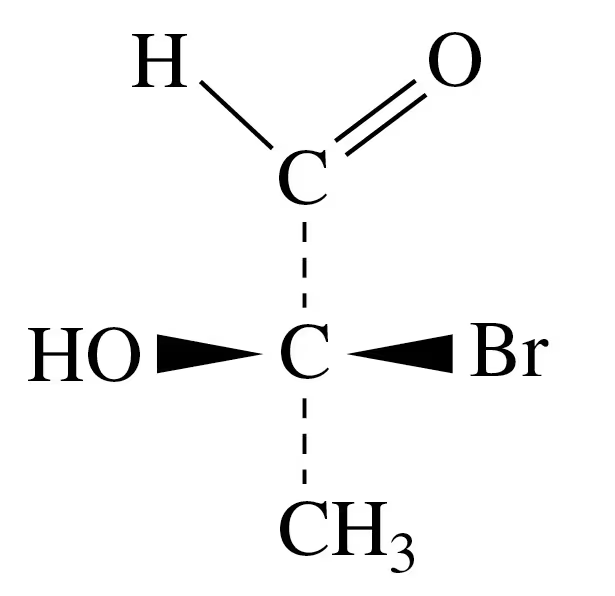
Draw the Fischer projection for each of the following wedge–dash structures:
a. Fischer projection of a carbohydrate with hydroxyl, bromine, and methyl groups attached to a carbon backbone.

검증된 단계별 안내
1
Understand the Fischer projection: A Fischer projection is a two-dimensional representation of a molecule where the carbon chain is drawn vertically, and horizontal lines represent bonds projecting out of the plane (toward the viewer), while vertical lines represent bonds projecting behind the plane (away from the viewer).
Identify the chiral carbon centers in the wedge–dash structure. Chiral carbons are carbon atoms bonded to four different groups. These will be the focus of the Fischer projection.
Orient the molecule so that the longest carbon chain is vertical, with the most oxidized carbon (e.g., a carbonyl group or the carbon attached to the most electronegative atom) at the top. This is the standard orientation for Fischer projections.
Convert the wedge–dash notation to the Fischer projection: Bonds shown as wedges (projecting out of the plane) should be drawn as horizontal lines in the Fischer projection, while bonds shown as dashes (projecting behind the plane) should be drawn as vertical lines.
Double-check the stereochemistry: Ensure that the relative positions of the substituents around each chiral carbon in the Fischer projection match the original wedge–dash structure. This ensures the correct 3D arrangement is preserved in the 2D representation.

비슷한 문제에 대한 검증된 영상 답변:

이 영상 해법은 위 문제에 도움이 된다고 튜터들이 추천한 것입니다.
영상 길이:
2m

주요 개념

질문에 올바르게 답하기 위해 반드시 이해해야 하는 핵심 개념들은 다음과 같습니다.

Fischer Projection

The Fischer projection is a two-dimensional representation of a three-dimensional organic molecule, particularly useful for depicting carbohydrates and amino acids. In this format, vertical lines represent bonds that extend behind the plane of the paper, while horizontal lines represent bonds that extend in front. This method simplifies the visualization of stereochemistry, allowing for easy identification of chiral centers and their configurations.
추천 영상:
가이드 코스
0:48
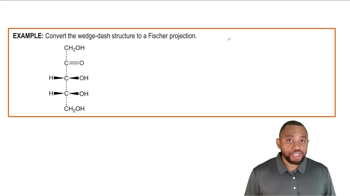
Fischer Projections Example 1

Wedge-Dash Notation

Wedge-dash notation is a way to represent the three-dimensional arrangement of atoms in a molecule. In this notation, solid wedges indicate bonds that project out of the plane of the paper towards the viewer, while dashed lines represent bonds that extend behind the plane. This visual tool helps chemists understand the spatial orientation of substituents around chiral centers, which is crucial for determining the molecule's stereochemistry.
추천 영상:
가이드 코스
01:41
Scientific Notation

Stereochemistry

Stereochemistry is the study of the spatial arrangement of atoms in molecules and how this arrangement affects their chemical properties and reactions. It is particularly important in organic chemistry, where the orientation of functional groups can influence a compound's reactivity and interactions. Understanding stereochemistry is essential for accurately converting between different representations of molecules, such as wedge-dash structures and Fischer projections.
추천 영상:
가이드 코스
1:30
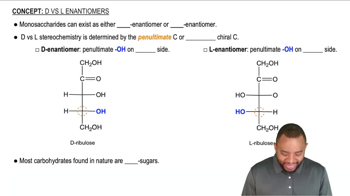
D vs L Enantiomers Concept 1