Ch.13 Carbohydrates
Timberlake - Chemistry: An Introduction to General, Organic, and Biological Chemistry 14th Edition
Timberlake14th EditionChemistry: An Introduction to General, Organic, and Biological ChemistryISBN: 9781292472249당신이 사용하는 게 아니라요?교과서 변경
13장, 문제 23c,d

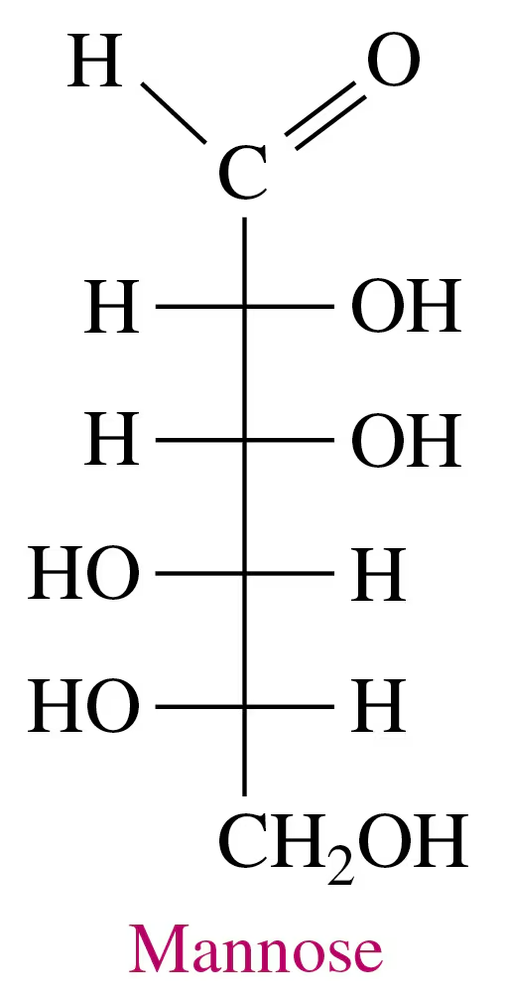
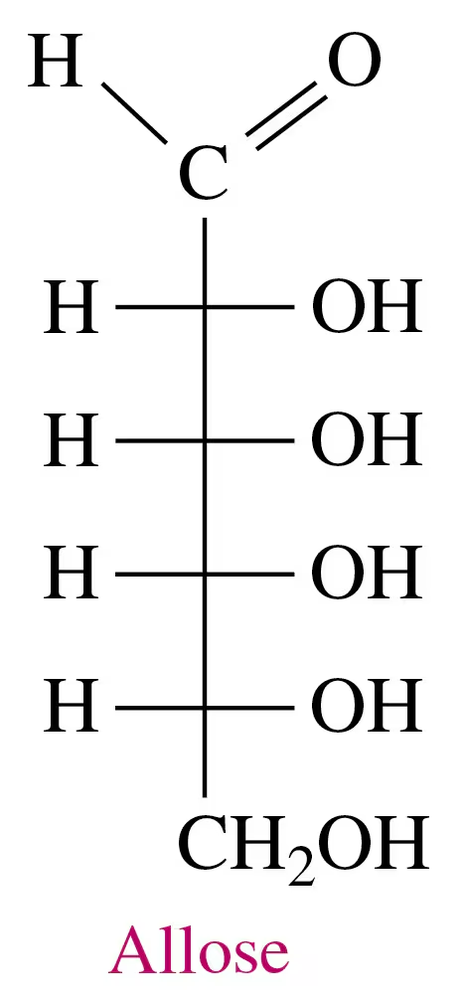
Draw the Fischer projection for the other enantiomer of c to d in problem 13.21.
c. Fischer projection of mannose, showing its structural formula with hydroxyl groups and a carbonyl group.
d. Fischer projection of Allose, a carbohydrate, showing its structural formula with hydroxyl groups.

검증된 단계별 안내
1
Understand the concept of a Fischer projection: A Fischer projection is a two-dimensional representation of a molecule, where the vertical lines represent bonds going into the plane (away from the viewer) and the horizontal lines represent bonds coming out of the plane (toward the viewer). The carbon chain is typically drawn vertically, with the most oxidized carbon at the top.
Identify the chiral center(s) in the molecule: A chiral center is a carbon atom bonded to four different groups. Locate the chiral center(s) in the given molecule (c to d in problem 13.21).
Determine the configuration of the given enantiomer: Analyze the spatial arrangement of the groups around the chiral center in the provided Fischer projection. Assign the configuration as R or S using the Cahn-Ingold-Prelog priority rules.
Invert the configuration to find the other enantiomer: To draw the Fischer projection of the other enantiomer, swap the positions of the groups on the horizontal bonds (left and right) while keeping the vertical bonds (top and bottom) unchanged. This inversion changes the configuration at the chiral center.
Redraw the Fischer projection: Carefully redraw the molecule with the inverted configuration, ensuring that the vertical and horizontal bonds are correctly represented. Verify that the new Fischer projection corresponds to the enantiomer of the original molecule.

비슷한 문제에 대한 검증된 영상 답변:

이 영상 해법은 위 문제에 도움이 된다고 튜터들이 추천한 것입니다.
영상 길이:
2m

주요 개념

질문에 올바르게 답하기 위해 반드시 이해해야 하는 핵심 개념들은 다음과 같습니다.

Fischer Projection

A Fischer projection is a two-dimensional representation of a three-dimensional organic molecule, particularly useful for depicting stereochemistry. In this format, vertical lines represent bonds that project away from the viewer, while horizontal lines indicate bonds that come towards the viewer. This method is commonly used for carbohydrates and amino acids to illustrate their stereoisomers.
추천 영상:
가이드 코스
0:48
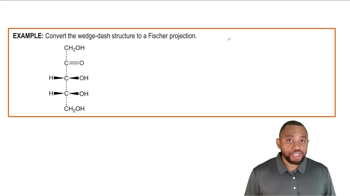
Fischer Projections Example 1

Enantiomers

Enantiomers are a type of stereoisomer that are non-superimposable mirror images of each other. They typically arise in molecules that contain one or more chiral centers, where the arrangement of atoms around the chiral center leads to two distinct configurations. Understanding enantiomers is crucial in fields like pharmacology, as different enantiomers can have vastly different biological effects.
추천 영상:
가이드 코스
3:33
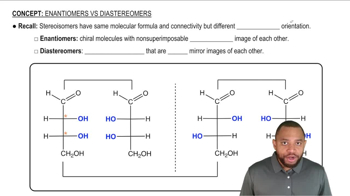
Enantiomers vs Diastereomers Concept 1

Chirality

Chirality refers to the geometric property of a molecule that makes it non-superimposable on its mirror image, akin to how left and right hands are mirror images but cannot be perfectly aligned. A chiral molecule usually contains at least one carbon atom bonded to four different substituents, creating two distinct configurations. Recognizing chirality is essential for predicting the behavior of molecules in biological systems and chemical reactions.
추천 영상:
가이드 코스
1:39
Chirality Example 1