Ch.13 Carbohydrates
Timberlake - Chemistry: An Introduction to General, Organic, and Biological Chemistry 14th Edition
Timberlake14th EditionChemistry: An Introduction to General, Organic, and Biological ChemistryISBN: 9781292472249당신이 사용하는 게 아니라요?교과서 변경
13장, 문제 33

Draw the Haworth structures for α- and ß-D-glucose.

검증된 단계별 안내
1
Understand the structure of D-glucose: D-glucose is an aldohexose, meaning it has six carbon atoms and an aldehyde group. In its cyclic form, it forms a six-membered ring (pyranose) by reacting the aldehyde group (C1) with the hydroxyl group on C5.
Determine the α- and ß-anomers: The difference between α- and ß-D-glucose lies in the orientation of the hydroxyl group attached to the anomeric carbon (C1). In the α-anomer, the hydroxyl group on C1 is trans (opposite side) to the CH2OH group on C5. In the ß-anomer, the hydroxyl group on C1 is cis (same side) to the CH2OH group on C5.
Draw the six-membered ring (pyranose): Represent the oxygen atom as part of the ring, connecting C1 to C5. Place the CH2OH group attached to C5 above the plane of the ring for D-glucose.
Add substituents to the ring: For each carbon atom (C2 to C4), place the hydroxyl groups and hydrogen atoms in the correct orientation based on the Fischer projection of D-glucose. Remember that D-glucose has the hydroxyl groups on C2 and C4 pointing to the right (down in the Haworth structure) and the hydroxyl group on C3 pointing to the left (up in the Haworth structure).
Label the α- and ß-anomers: For the α-anomer, draw the hydroxyl group on C1 pointing down (trans to CH2OH). For the ß-anomer, draw the hydroxyl group on C1 pointing up (cis to CH2OH). Ensure all other substituents remain consistent between the two structures.

비슷한 문제에 대한 검증된 영상 답변:

이 영상 해법은 위 문제에 도움이 된다고 튜터들이 추천한 것입니다.
영상 길이:
7m
도움이 되었나요?

주요 개념

질문에 올바르게 답하기 위해 반드시 이해해야 하는 핵심 개념들은 다음과 같습니다.

Haworth Projection

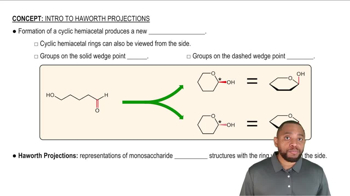
The Haworth projection is a way of representing the cyclic forms of monosaccharides, such as glucose, in a two-dimensional format. It illustrates the arrangement of atoms in a sugar molecule, showing how the carbon atoms are connected in a ring structure. This representation helps visualize the stereochemistry of the molecule, particularly the orientation of hydroxyl (–OH) groups.
추천 영상:
가이드 코스
2:18
Intro to Haworth Projections Concept 1

Anomeric Carbon

The anomeric carbon is the carbon atom in a sugar molecule that becomes a new chiral center when the sugar cyclizes. In D-glucose, this is the first carbon (C1) that can exist in two different configurations, leading to the formation of α- and ß-anomers. The distinction between these forms is crucial for understanding the reactivity and properties of carbohydrates.
추천 영상:
가이드 코스
5:36
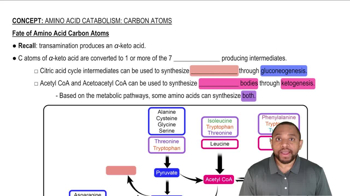
Amino Acid Catabolism: Carbon Atoms Concept 2

α- and ß-D-Glucose

α- and ß-D-glucose are two anomeric forms of D-glucose that differ in the orientation of the hydroxyl group attached to the anomeric carbon (C1). In α-D-glucose, the –OH group is positioned below the plane of the ring, while in ß-D-glucose, it is above the plane. This difference affects the physical and chemical properties of the sugars, influencing their roles in biological systems.
추천 영상:
가이드 코스
2:48
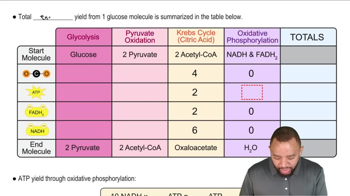
Total Energy From Glucose Concept 2