Ch.14 Carboxylic Acids, Esters, Amines, and Amides
Timberlake - Chemistry: An Introduction to General, Organic, and Biological Chemistry 14th Edition
Timberlake14th EditionChemistry: An Introduction to General, Organic, and Biological ChemistryISBN: 9781292472249당신이 사용하는 게 아니라요?교과서 변경
14장, 문제 45d

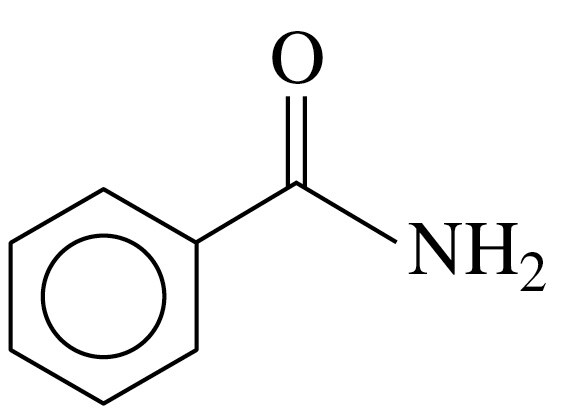
Draw the condensed structural or line-angle formulas for the products from the hydrolysis of each of the following amides with HCl:
d. Condensed structural formula of an amide featuring a benzene ring, carbonyl group, and an amine group.

검증된 단계별 안내
1
Identify the functional group in the given amide. Amides are characterized by a carbonyl group (C=O) directly bonded to a nitrogen atom (N).
Understand the hydrolysis reaction of an amide in the presence of HCl. Hydrolysis involves breaking the amide bond (C-N bond) using water, and in the presence of HCl, the products are a carboxylic acid and an ammonium salt.
Determine the structure of the carboxylic acid product. The carbonyl carbon of the amide becomes part of the carboxylic acid group (COOH) after hydrolysis.
Determine the structure of the ammonium salt product. The nitrogen atom from the amide reacts with HCl to form an ammonium ion (NH₄⁺ or a substituted ammonium ion, depending on the structure of the amide).
Draw the condensed structural or line-angle formulas for both the carboxylic acid and the ammonium salt products, ensuring that the correct number of hydrogens and bonds are represented based on the original amide structure.

비슷한 문제에 대한 검증된 영상 답변:

이 영상 해법은 위 문제에 도움이 된다고 튜터들이 추천한 것입니다.
영상 길이:
54s
도움이 되었나요?

주요 개념

질문에 올바르게 답하기 위해 반드시 이해해야 하는 핵심 개념들은 다음과 같습니다.

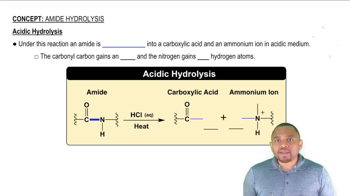
Hydrolysis of Amides

Hydrolysis of amides involves the reaction of an amide with water, often in the presence of an acid or base, to produce a carboxylic acid and an amine or ammonia. In this process, the carbonyl carbon of the amide is attacked by water, leading to the cleavage of the C-N bond and the formation of the respective products.
추천 영상:
가이드 코스
1:12
Acidic Hydrolysis Concept 1

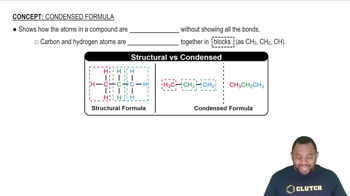
Condensed Structural Formula

A condensed structural formula provides a simplified representation of a molecule, showing the arrangement of atoms and the connectivity between them without depicting all the bonds explicitly. It is useful for visualizing the structure of organic compounds, allowing chemists to quickly understand the molecular framework and functional groups present.
추천 영상:
가이드 코스
1:53
Condensed Formula Concept 1

Line-Angle Formula

The line-angle formula, also known as the skeletal formula, is a shorthand representation of organic molecules where vertices represent carbon atoms and lines represent bonds. This method simplifies the drawing of complex structures by omitting hydrogen atoms attached to carbons, making it easier to visualize larger organic compounds and their connectivity.
추천 영상:
가이드 코스
01:24
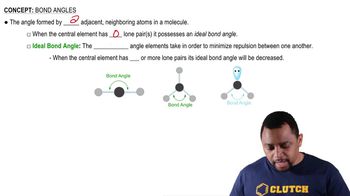
Bond Angles (Simplified) Concept 1