Ch.14 Carboxylic Acids, Esters, Amines, and Amides
Timberlake - Chemistry: An Introduction to General, Organic, and Biological Chemistry 14th Edition
Timberlake14th EditionChemistry: An Introduction to General, Organic, and Biological ChemistryISBN: 9781292472249당신이 사용하는 게 아니라요?교과서 변경
14장, 문제 80e

Ethyl octanoate is a flavor component of mangoes.
<IMAGE>
e. How many milliliters of a 0.315 M NaOH solution is needed to completely hydrolyze (saponify) 2.84 g of ethyl octanoate?

검증된 단계별 안내
1
Step 1: Write the balanced chemical equation for the hydrolysis (saponification) reaction. Ethyl octanoate (C10H20O2) reacts with NaOH to produce ethanol (C2H5OH) and sodium octanoate (C8H15O2Na). The reaction is: C1020O2 + NaOH → C25OH + C815O2Na.
Step 2: Calculate the molar mass of ethyl octanoate (C10H20O2). Add the atomic masses of all the atoms in the molecule: Carbon (C) = 12.01 g/mol, Hydrogen (H) = 1.008 g/mol, and Oxygen (O) = 16.00 g/mol. The molar mass is: (10 × 12.01) + (20 × 1.008) + (2 × 16.00) g/mol.
Step 3: Determine the number of moles of ethyl octanoate in 2.84 g. Use the formula: massmolar mass. Substitute the given mass (2.84 g) and the molar mass calculated in Step 2.
Step 4: Use the stoichiometry of the reaction to find the moles of NaOH required. From the balanced equation, the molar ratio of ethyl octanoate to NaOH is 1:1. Therefore, the moles of NaOH required are equal to the moles of ethyl octanoate calculated in Step 3.
Step 5: Calculate the volume of 0.315 M NaOH solution needed. Use the formula: moles of solutemolarity. Substitute the moles of NaOH (from Step 4) and the molarity of the NaOH solution (0.315 M). Convert the result to milliliters (1 L = 1000 mL).

비슷한 문제에 대한 검증된 영상 답변:

이 영상 해법은 위 문제에 도움이 된다고 튜터들이 추천한 것입니다.
영상 길이:
5m

주요 개념

질문에 올바르게 답하기 위해 반드시 이해해야 하는 핵심 개념들은 다음과 같습니다.

Saponification Reaction

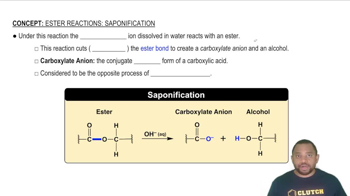
Saponification is a chemical reaction between a fat or oil and a base, typically sodium hydroxide (NaOH), resulting in the formation of glycerol and soap. In this context, ethyl octanoate, an ester, undergoes hydrolysis in the presence of NaOH to produce octanoic acid and ethanol. Understanding this reaction is crucial for calculating the amount of NaOH needed for complete hydrolysis.
추천 영상:
가이드 코스
1:25
Ester Reactions: Saponification Concept 1

Molarity (M)

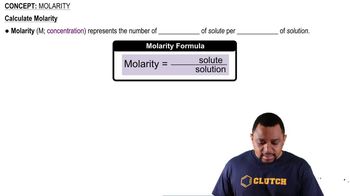
Molarity is a measure of concentration defined as the number of moles of solute per liter of solution. In this problem, the NaOH solution has a molarity of 0.315 M, indicating that there are 0.315 moles of NaOH in every liter of solution. This concept is essential for determining how much volume of the NaOH solution is required to react with the given mass of ethyl octanoate.
추천 영상:

Stoichiometry

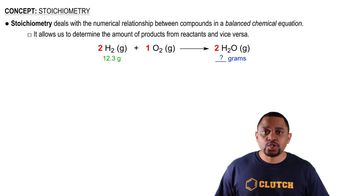
Stoichiometry involves the calculation of reactants and products in chemical reactions based on balanced equations. To solve the problem, one must first determine the moles of ethyl octanoate from its mass and then use the stoichiometric coefficients from the saponification reaction to find the corresponding moles of NaOH needed. This concept is fundamental for accurately calculating the volume of NaOH required.
추천 영상: