Ch.14 Carboxylic Acids, Esters, Amines, and Amides
Timberlake - Chemistry: An Introduction to General, Organic, and Biological Chemistry 14th Edition
Timberlake14th EditionChemistry: An Introduction to General, Organic, and Biological ChemistryISBN: 9781292472249당신이 사용하는 게 아니라요?교과서 변경
14장, 문제 36d

Indicate if each of the following is soluble in water. Explain.
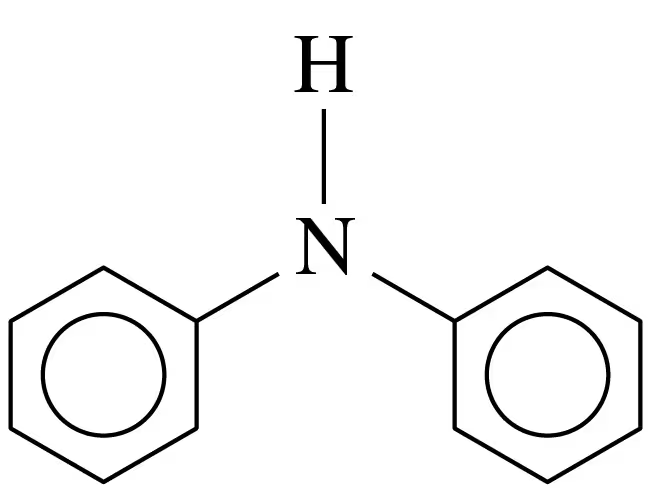
d. Chemical structure of diphenylamine, featuring a nitrogen atom bonded to two phenyl groups.

검증된 단계별 안내
1
Identify the compound in the image provided. If the image is not visible, the compound's name or formula should be clarified to proceed.
Determine the type of compound (ionic or covalent). Ionic compounds generally consist of a metal and a nonmetal, while covalent compounds consist of nonmetals only.
For ionic compounds, use solubility rules to determine if the compound is soluble in water. For example, compounds containing alkali metal cations (e.g., Na⁺, K⁺) or ammonium (NH₄⁺), as well as nitrates (NO₃⁻) and acetates (CH₃COO⁻), are typically soluble.
For covalent compounds, consider their polarity. Polar covalent compounds (e.g., those with O-H or N-H bonds) are more likely to dissolve in water due to hydrogen bonding, while nonpolar covalent compounds are generally insoluble.
Explain the reasoning based on the compound's structure and the solubility rules or polarity analysis. Conclude whether the compound is soluble or insoluble in water.

비슷한 문제에 대한 검증된 영상 답변:

이 영상 해법은 위 문제에 도움이 된다고 튜터들이 추천한 것입니다.
영상 길이:
1m

주요 개념

질문에 올바르게 답하기 위해 반드시 이해해야 하는 핵심 개념들은 다음과 같습니다.

Solubility

Solubility refers to the ability of a substance to dissolve in a solvent, typically water. It is influenced by factors such as temperature, pressure, and the nature of the solute and solvent. Polar substances tend to dissolve well in polar solvents like water, while nonpolar substances do not. Understanding solubility is crucial for predicting how substances interact in aqueous solutions.
추천 영상:
가이드 코스
00:28
Solubility Rules

Polarity

Polarity is a property of molecules that describes the distribution of electrical charge. Polar molecules have a significant difference in electronegativity between atoms, leading to partial positive and negative charges. Water is a polar molecule, which allows it to effectively dissolve other polar substances, while nonpolar molecules, lacking this charge separation, do not interact favorably with water.
추천 영상:
가이드 코스
01:34
Molecular Polarity (Simplified) Concept 1

Ionic and Molecular Compounds

Ionic compounds are formed from the electrostatic attraction between positively and negatively charged ions, while molecular compounds consist of molecules formed by covalent bonds. Ionic compounds generally dissolve in water due to their ability to dissociate into ions, which interact with water molecules. In contrast, many molecular compounds may not dissolve well if they are nonpolar, highlighting the importance of understanding the nature of the compounds in question.
추천 영상:
가이드 코스
02:11
Naming Ionic Compounds