Ch.14 Carboxylic Acids, Esters, Amines, and Amides
Timberlake - Chemistry: An Introduction to General, Organic, and Biological Chemistry 14th Edition
Timberlake14th EditionChemistry: An Introduction to General, Organic, and Biological ChemistryISBN: 9781292472249당신이 사용하는 게 아니라요?교과서 변경
14장, 문제 56

There are four amide isomers with the molecular formula C3H7NO. Draw their condensed structural formulas and write the IUPAC name for each.

검증된 단계별 안내
1
Step 1: Understand the molecular formula C3H7NO. This formula indicates that the compound contains 3 carbon atoms, 7 hydrogen atoms, 1 nitrogen atom, and 1 oxygen atom. Since the problem specifies amide isomers, the functional group must include a carbonyl group (C=O) directly bonded to a nitrogen atom (N).
Step 2: Recall the general structure of an amide. Amides have the functional group R-CONH2, where R is a hydrocarbon group. For isomers, the arrangement of the carbon atoms and the placement of the functional group can vary while maintaining the same molecular formula.
Step 3: Draw the first isomer: Propanamide. This is the simplest arrangement where the carbon chain is unbranched, and the amide group is at the end. The condensed structural formula is CH3CH2CONH2, and the IUPAC name is propanamide.
Step 4: Draw the second isomer: N-Methylacetamide. In this structure, one hydrogen atom on the nitrogen is replaced by a methyl group. The condensed structural formula is CH3CONHCH3, and the IUPAC name is N-methylacetamide.
Step 5: Draw the third and fourth isomers: These involve branching of the carbon chain. For example, one isomer is 2-Methylpropanamide (CH3CH(CH3)CONH2), where a methyl group is attached to the second carbon of the chain. Another isomer is N-Ethylformamide (HCONHCH2CH3), where the nitrogen is bonded to an ethyl group. Write their condensed structural formulas and IUPAC names accordingly.

비슷한 문제에 대한 검증된 영상 답변:

이 영상 해법은 위 문제에 도움이 된다고 튜터들이 추천한 것입니다.
영상 길이:
8m
도움이 되었나요?

주요 개념

질문에 올바르게 답하기 위해 반드시 이해해야 하는 핵심 개념들은 다음과 같습니다.

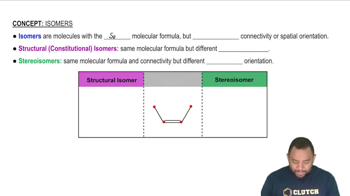
Amide Isomers

Amide isomers are compounds that share the same molecular formula but differ in the arrangement of atoms. For C3H7NO, the isomers can vary in the positioning of the carbonyl group and the nitrogen atom, leading to different structural forms. Understanding isomerism is crucial for identifying and naming these compounds accurately.
추천 영상:
가이드 코스
2:16
Isomers Concept 1

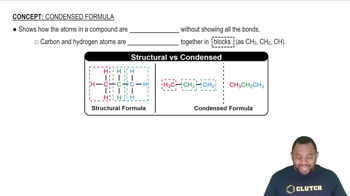
Condensed Structural Formula

A condensed structural formula provides a simplified representation of a molecule, showing how atoms are connected without depicting all bonds explicitly. It is useful for visualizing the structure of isomers quickly. For amides, the formula typically indicates the presence of the carbonyl group (C=O) and the amine group (NH2) in a compact format.
추천 영상:
가이드 코스
1:53
Condensed Formula Concept 1

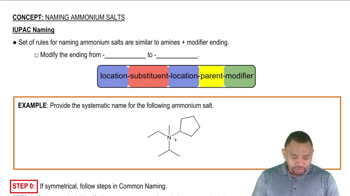
IUPAC Nomenclature

IUPAC nomenclature is a systematic method for naming chemical compounds based on their structure and functional groups. For amides, the naming convention involves identifying the longest carbon chain, indicating the presence of the amide functional group, and using appropriate suffixes and prefixes. This ensures that each compound has a unique and universally accepted name.
추천 영상:
가이드 코스
3:18
IUPAC Naming Concept 3