Ch.15 Lipids
Timberlake - Chemistry: An Introduction to General, Organic, and Biological Chemistry 14th Edition
Timberlake14th EditionChemistry: An Introduction to General, Organic, and Biological ChemistryISBN: 9781292472249당신이 사용하는 게 아니라요?교과서 변경
15장, 문제 39

Describe the similarities and differences between triacylglycerols and glycerophospholipids.

검증된 단계별 안내
1
Triacylglycerols and glycerophospholipids are both lipids derived from glycerol, which serves as the backbone for their structure. Begin by identifying the common structural feature: both molecules contain a glycerol backbone to which fatty acids are attached via ester bonds.
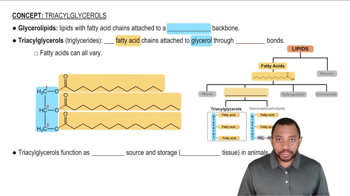
Triacylglycerols consist of three fatty acid chains attached to the three hydroxyl groups of glycerol. This makes them nonpolar and hydrophobic, meaning they are not soluble in water. They are primarily used for energy storage in the body.
Glycerophospholipids, on the other hand, have two fatty acid chains attached to the first two hydroxyl groups of glycerol, while the third hydroxyl group is bonded to a phosphate group. This phosphate group is often further linked to a polar head group, such as choline or ethanolamine, making glycerophospholipids amphipathic (having both hydrophobic and hydrophilic regions).
The key difference lies in their function: triacylglycerols are primarily used for long-term energy storage, while glycerophospholipids are major components of cell membranes, contributing to their structure and function.
Summarize the similarities and differences: Both molecules share a glycerol backbone and fatty acid chains, but triacylglycerols are fully hydrophobic and used for energy storage, whereas glycerophospholipids are amphipathic and play a structural role in cell membranes.

비슷한 문제에 대한 검증된 영상 답변:

이 영상 해법은 위 문제에 도움이 된다고 튜터들이 추천한 것입니다.
영상 길이:
3m
도움이 되었나요?

주요 개념

질문에 올바르게 답하기 위해 반드시 이해해야 하는 핵심 개념들은 다음과 같습니다.

Triacylglycerols

Triacylglycerols, also known as triglycerides, are lipids composed of three fatty acid molecules esterified to a glycerol backbone. They serve primarily as energy storage molecules in adipose tissue and are a major component of dietary fats. Their structure allows for efficient energy storage, as they can be broken down into fatty acids and glycerol when energy is needed.
추천 영상:
가이드 코스
1:52
Triacylglycerols Concept 1

Glycerophospholipids

Glycerophospholipids are a class of lipids that consist of two fatty acids, a glycerol backbone, and a phosphate group. They are key components of cell membranes, providing structural integrity and fluidity. The presence of a phosphate group allows for the formation of hydrophilic (water-attracting) and hydrophobic (water-repelling) regions, which is crucial for membrane function.
추천 영상:
가이드 코스
1:09
Glycerophospholipids Example 2

Structural Differences

The primary structural difference between triacylglycerols and glycerophospholipids lies in their composition. Triacylglycerols contain three fatty acids, while glycerophospholipids have only two fatty acids and a phosphate group. This difference in structure leads to distinct functions: triacylglycerols are mainly for energy storage, whereas glycerophospholipids are essential for forming cellular membranes.
추천 영상:
가이드 코스
1:01
Structural Formula Concept 2