Ch.15 Lipids
Timberlake - Chemistry: An Introduction to General, Organic, and Biological Chemistry 14th Edition
Timberlake14th EditionChemistry: An Introduction to General, Organic, and Biological ChemistryISBN: 9781292472249당신이 사용하는 게 아니라요?교과서 변경
15장, 문제 7b

Draw the line-angle formula for each of the following fatty acids:
a. palmitic acid

검증된 단계별 안내
1
Understand the structure of palmitic acid: Palmitic acid is a saturated fatty acid with the molecular formula C16H32O2. It consists of a 16-carbon chain with no double bonds and a carboxylic acid (-COOH) functional group at one end.
Identify the components of the line-angle formula: In a line-angle formula, each vertex represents a carbon atom, and lines represent bonds between them. Hydrogen atoms bonded to carbon are implied and not explicitly shown unless part of a functional group.
Start drawing the chain: Begin with the carboxylic acid group (-COOH) at one end. Represent the carbon of the carboxylic acid as a vertex, and draw a double bond to oxygen and a single bond to a hydroxyl group (-OH).
Extend the carbon chain: Draw a straight chain of 15 additional carbon atoms connected by single bonds. Each vertex represents a carbon atom, and the chain should be linear since palmitic acid is saturated.
Verify the structure: Ensure the chain has 16 carbons in total, with the carboxylic acid group at one end. Double-check that there are no double bonds in the chain, as palmitic acid is fully saturated.

비슷한 문제에 대한 검증된 영상 답변:

이 영상 해법은 위 문제에 도움이 된다고 튜터들이 추천한 것입니다.
영상 길이:
2m

주요 개념

질문에 올바르게 답하기 위해 반드시 이해해야 하는 핵심 개념들은 다음과 같습니다.

Line-Angle Formula

The line-angle formula, also known as the skeletal formula, is a simplified way of representing organic molecules. In this representation, carbon atoms are implied at the ends of lines and at intersections, while hydrogen atoms are usually omitted for clarity. This method allows chemists to visualize the structure of molecules quickly and efficiently, focusing on the connectivity of atoms rather than individual bonds.
추천 영상:
가이드 코스
01:24
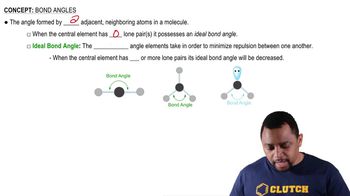
Bond Angles (Simplified) Concept 1

Fatty Acids

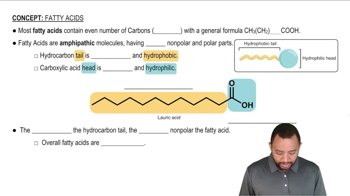
Fatty acids are carboxylic acids with long hydrocarbon chains, which can be saturated or unsaturated. Saturated fatty acids, like palmitic acid, contain no double bonds between carbon atoms, resulting in a straight chain structure. Understanding the structure of fatty acids is crucial for studying their properties and biological functions, as they play significant roles in energy storage and cell membrane composition.
추천 영상:
가이드 코스
2:00
Fatty Acids Concept 1

Palmitic Acid

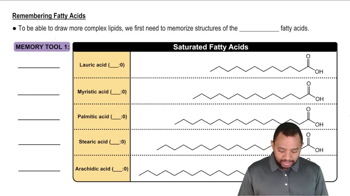
Palmitic acid is a saturated fatty acid with the chemical formula C16H32O2, consisting of a 16-carbon chain and a carboxylic acid group. It is one of the most common fatty acids found in animals and plants, often serving as a building block for lipids. Recognizing its structure is essential for understanding its role in metabolism and its impact on health, particularly in relation to dietary fats.
추천 영상:
가이드 코스
1:50
Fatty Acids Concept 5