Ch.15 Lipids
Timberlake - Chemistry: An Introduction to General, Organic, and Biological Chemistry 14th Edition
Timberlake14th EditionChemistry: An Introduction to General, Organic, and Biological ChemistryISBN: 9781292472249당신이 사용하는 게 아니라요?교과서 변경
15장, 문제 65a

Identify the type of transport described by each of the following:
b. O2 moves into the cell from a higher concentration outside the cell.

검증된 단계별 안내
1
Determine the type of molecule involved in the transport. In this case, O₂ is a small, nonpolar molecule.
Analyze the concentration gradient. The problem states that O₂ moves from a higher concentration outside the cell to a lower concentration inside the cell.
Recall the types of transport mechanisms. Passive transport mechanisms include diffusion, facilitated diffusion, and osmosis. Active transport requires energy and moves substances against their concentration gradient.
Identify the specific type of passive transport. Since O₂ is a small, nonpolar molecule, it can move directly through the lipid bilayer of the cell membrane without the need for a transport protein or energy input. This process is called simple diffusion.
Conclude that the type of transport described is simple diffusion, as it involves the movement of O₂ down its concentration gradient without the use of energy or transport proteins.

비슷한 문제에 대한 검증된 영상 답변:

이 영상 해법은 위 문제에 도움이 된다고 튜터들이 추천한 것입니다.
영상 길이:
3m

주요 개념

질문에 올바르게 답하기 위해 반드시 이해해야 하는 핵심 개념들은 다음과 같습니다.

Diffusion

Diffusion is the process by which molecules move from an area of higher concentration to an area of lower concentration. This passive transport mechanism does not require energy and is driven by the concentration gradient. In the context of the question, oxygen (O₂) moves into the cell through diffusion, as it travels from a region where it is more concentrated outside the cell to a region of lower concentration inside.
추천 영상:
가이드 코스
1:23
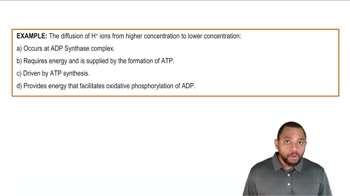
Oxidative Phosphorylation Example 1

Concentration Gradient

A concentration gradient refers to the difference in the concentration of a substance between two areas. It is a key factor in determining the direction of diffusion. In the example provided, the concentration gradient of O₂ drives its movement into the cell, as molecules naturally tend to move toward areas of lower concentration until equilibrium is reached.
추천 영상:
가이드 코스
00:52
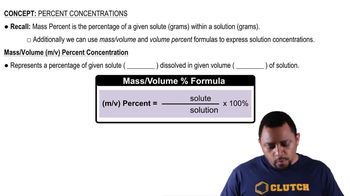
Percent Concentrations Concept 1

Passive Transport

Passive transport is a biological process that allows substances to cross membranes without the need for energy input. This includes processes like diffusion and osmosis, where molecules move along their concentration gradient. The transport of O₂ into the cell is an example of passive transport, as it occurs spontaneously due to the existing concentration gradient.
추천 영상:
가이드 코스
1:21
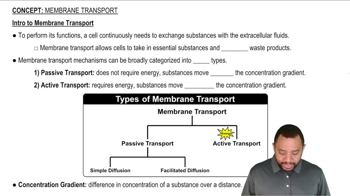
Membrane Transport Concept 1